
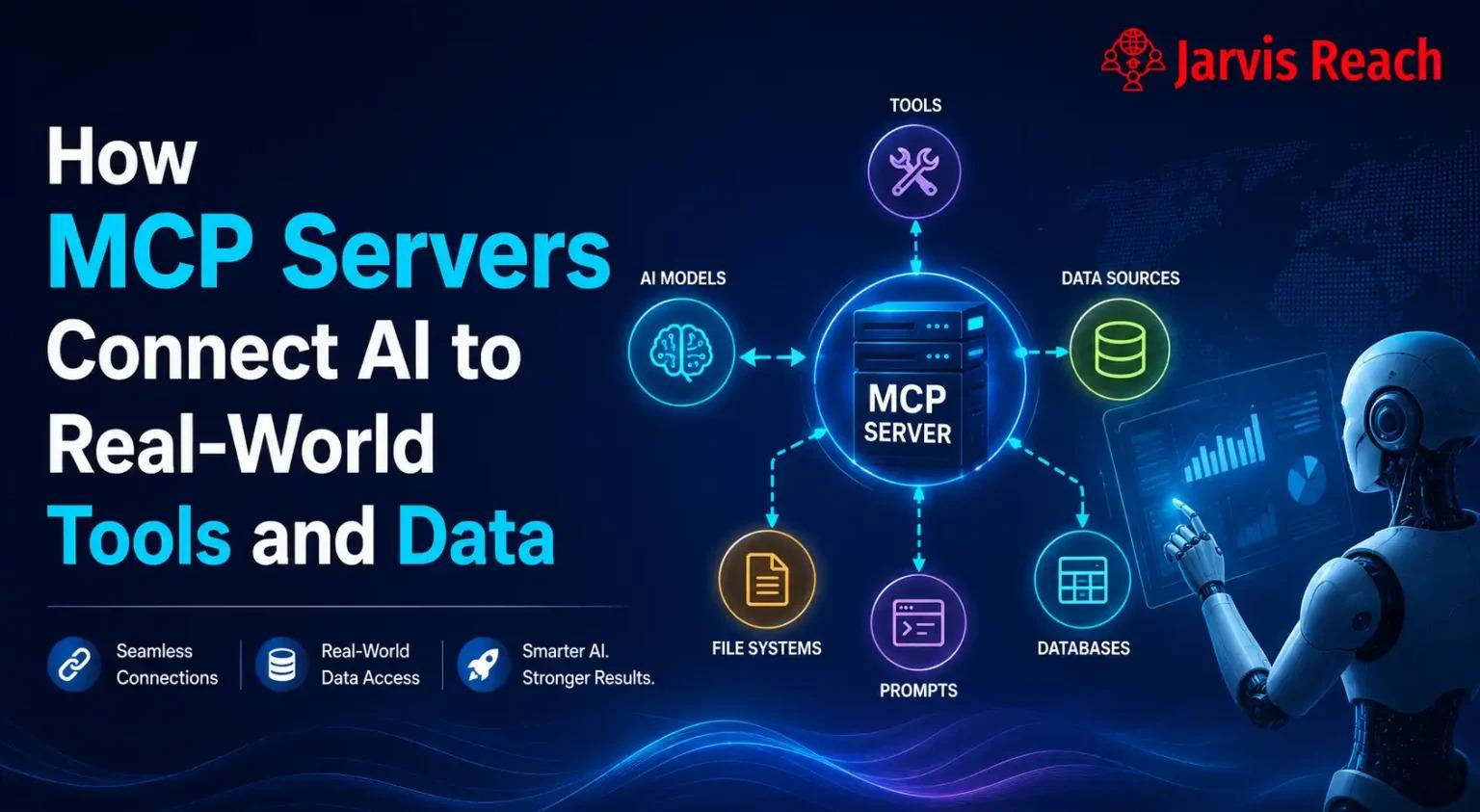
Artificial intelligence is transforming how organizations manage information, automate workflows, and interact with customers. However, AI models become truly valuable only when they can access real-world information and business applications. This is where an MCP Server plays a critical role.
Model Context Protocol (MCP) provides a standardized way for AI systems to communicate with external resources, making it easier to connect AI platforms with databases, APIs, enterprise tools, and file systems. As businesses continue to adopt AI, MCP Servers are emerging as a foundational component of modern AI infrastructure.
What Is an MCP Server?
An MCP Server acts as a bridge between an AI model and external systems. Instead of building custom integrations for every application, developers can use MCP to create a single communication layer that connects AI with multiple services.
This approach reduces complexity while improving flexibility and scalability.
The Role of the MCP Client
Every MCP environment includes an MCP Client, which serves as the communication endpoint for the AI application.
The MCP Client is responsible for:
- Sending requests
- Receiving responses
- Managing communication sessions
- Accessing external resources
By using a standardized protocol, MCP Clients can interact with various systems without requiring separate integrations for each one.
API Connectivity Made Simple
Most business applications rely on an API to exchange information. MCP Servers make it possible for AI systems to communicate with multiple APIs through a unified framework.
Benefits include:
- Faster integrations
- Reduced development effort
- Improved compatibility
- Easier maintenance
This allows AI models to access services ranging from CRM platforms to productivity tools and analytics applications.
Unlocking Enterprise Data
Organizations generate vast amounts of enterprise data every day. Unfortunately, much of this information is often scattered across multiple systems.
MCP Servers help AI applications access:
- Internal documents
- Customer records
- Knowledge bases
- Operational reports
- Business intelligence tools
This enables AI to provide more accurate, context-aware responses and recommendations.
Accessing SQL Databases
Many organizations store mission-critical information in SQL databases. MCP provides a secure and efficient way for AI systems to retrieve and analyze database information.
Common use cases include:
- Business reporting
- Customer support
- Data analysis
- Information retrieval
- Workflow automation
Users can interact with databases through natural language instead of writing complex queries.
Connecting Multiple Data Sources
Businesses rely on numerous data sources to operate efficiently.
Examples include:
- Cloud applications
- ERP systems
- CRM platforms
- Data warehouses
- External APIs
MCP creates a centralized access layer that simplifies communication between AI systems and these resources.
Improving Consistency with Prompt Templates
AI performance often depends on how instructions are structured. Prompt templates help standardize interactions and improve response quality.
Organizations use prompt templates for:
- Customer service workflows
- Knowledge retrieval
- Data processing
- Document analysis
When combined with MCP Servers, prompt templates help create predictable and reliable AI experiences.
Stateless and Stateful Architectures
MCP Servers can operate in either stateless or stateful modes.
Stateless Systems
A stateless server treats every request independently.
Advantages include:
- Better scalability
- Lower resource consumption
- Easier deployment
Stateful Systems
A stateful server retains information between interactions.
Benefits include:
- Personalized experiences
- Context awareness
- Multi-step workflow support
The choice depends on application requirements and business goals.
Authentication and Security
Strong authentication mechanisms are essential when AI systems access sensitive resources.
MCP Servers commonly support:
- API keys
- OAuth authentication
- Role-based access control
- Single sign-on solutions
These security measures help organizations maintain compliance while protecting critical information.
Integrating Backends and File Systems
Modern businesses operate a wide range of backends and file systems that contain valuable information.
Examples include:
- Cloud storage platforms
- Shared drives
- Content management systems
- Internal software applications
- Legacy business systems
MCP Servers provide AI applications with secure access to these resources without requiring extensive redevelopment.
Why Every AI Platform Needs MCP
A successful AI platform requires more than a language model. It needs reliable access to tools, data, and business systems.
MCP delivers:
- Standardized integrations
- Enhanced security
- Better scalability
- Faster deployment
- Simplified maintenance
By creating a unified communication layer, MCP helps organizations maximize the value of their AI investments.
The Future of MCP Servers
As AI adoption accelerates, businesses need efficient ways to connect models with enterprise systems. MCP Servers provide the infrastructure necessary to support this transformation.
By linking MCP Clients, APIs, enterprise data, SQL databases, data sources, prompt templates, authentication systems, backends, stateful workflows, stateless services, and file systems, MCP enables the next generation of intelligent applications.
Conclusion
MCP Server technology is becoming a cornerstone of modern AI development. It simplifies communication between AI models and external resources while improving security, scalability, and operational efficiency.
Whether you're building an AI platform, integrating enterprise data, managing SQL databases, or connecting multiple APIs and file systems, MCP provides a future-ready solution that supports innovation and long-term growth.

 English
