
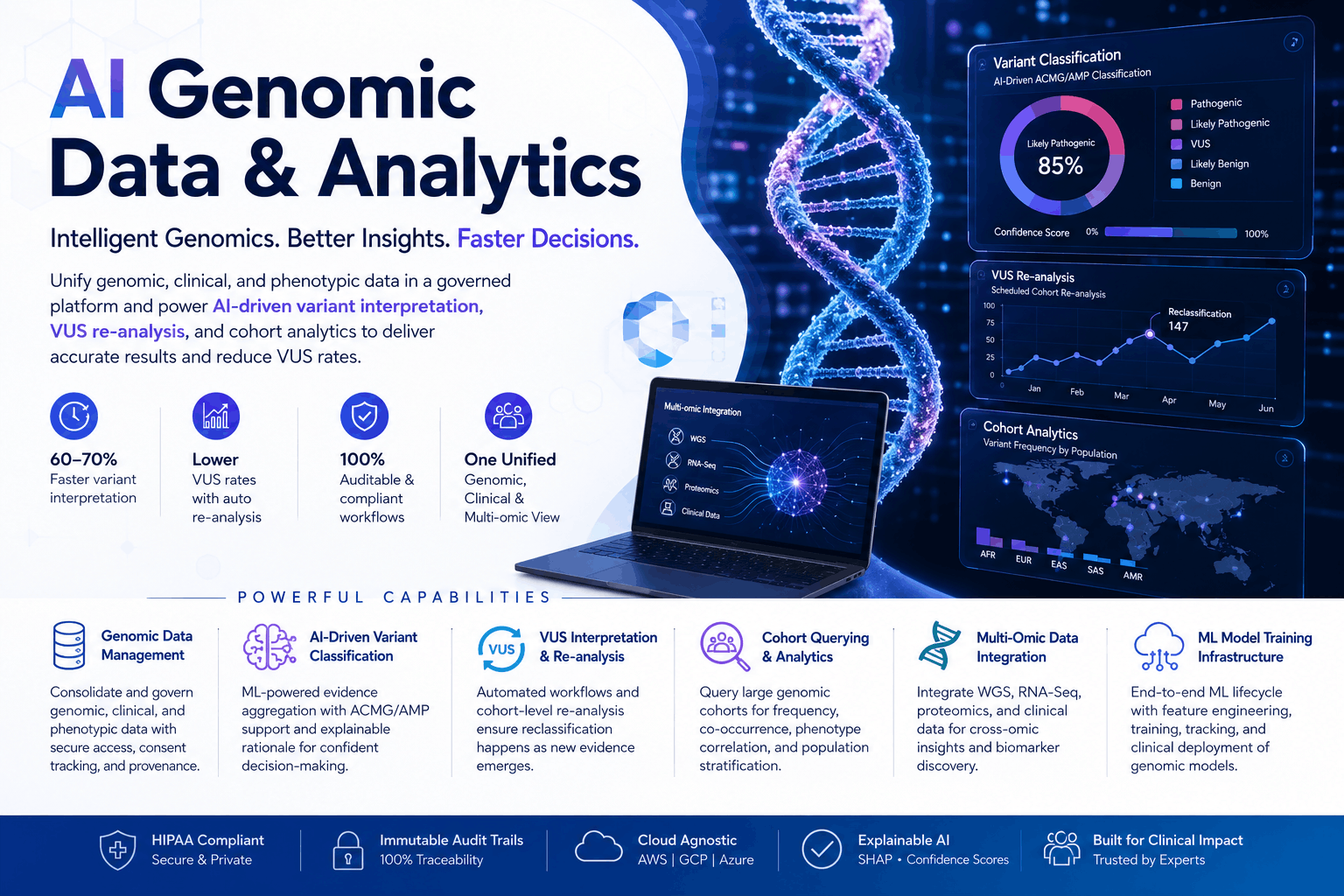
Genomic sequencing has made it possible to generate more biological and clinical data than ever before. The challenge for many laboratories is no longer producing genomic data. It is managing that data, interpreting it consistently, and keeping up as new evidence changes what individual variants may mean.
A clinical genomics program may work with whole genome sequencing, whole exome sequencing, targeted panels, clinical records, phenotype information, RNA sequencing, and other omic datasets. When this information sits across disconnected systems, interpretation can become slow and difficult to scale.
This is where an AI genomic data and analytics platform can help.
By combining governed genomic data management with AI-assisted variant interpretation, VUS reanalysis, cohort analytics, multi-omic integration, and machine learning infrastructure, organizations can create a more connected workflow from genomic data to clinical or research insight.
Why Genomic Data Management Is Becoming a Bigger Challenge
Modern genomics generates more than variant files.
Clinical and research teams may need to work with:
- Variant calls
- Clinical annotations
- Population frequency information
- Phenotypic data
- RNA-Seq expression data
- Proteomic data
- Internal laboratory evidence
- Published research
- Patient and sample metadata
Managing these datasets separately creates several problems.
Researchers may spend time finding and reconciling information instead of analyzing it. Clinical teams may have difficulty tracing where a classification came from. Previously interpreted variants may also require manual review when new evidence becomes available.
A genomic data management platform provides a structured environment where genomic, clinical, and phenotypic datasets can be connected using shared identifiers while maintaining access controls, consent tracking, and data provenance.
The objective is simple: make genomic information easier to find, understand, analyze, and govern.
What AI Adds to Genomic Interpretation
AI does not remove the need for clinical scientists or qualified variant interpreters.
Its value is in helping experts handle large amounts of evidence more efficiently.
For example, an AI-assisted workflow can help collect and organize information from genomic databases, computational prediction tools, published evidence, and internal laboratory records.
Instead of manually moving between multiple resources for every variant, an interpreter can start with a consolidated evidence view.
The workflow can then present:
- Relevant population frequency data
- Clinical database information
- Functional prediction results
- Splicing predictions
- Internal laboratory evidence
- Classification criteria
- Confidentiality information
- An explanation of the evidence supporting the suggested classification
The clinical or scientific expert can then review the evidence, make adjustments when appropriate, and sign off on the final interpretation.
That human review remains particularly important when genomic findings influence clinical decisions.
AI Driven Variant Classification
Variant classification can become a significant workload for laboratories processing large numbers of samples.
An AI-driven variant classification workflow can automate parts of the evidence gathering and organization process.
The platform described by NonStop can aggregate evidence from resources such as:
- gnomeAD
- ClinVar
- REVEL
- CADD
- SpliceAI
- Internal laboratory history
This evidence can be organized around ACMG/AMP classification workflows and presented with confidence scores and human-readable rationale.
The goal is not to ask an AI model to make an unexplained clinical decision.
Instead, AI can help create a structured evidence dossier that allows an interpreter to review the relevant information more quickly.
This distinction is important when building AI systems for clinical genomics. Automation should improve the workflow while preserving expert oversight and an auditable decision trail.
Making Genomic AI Explainable
One of the biggest challenges with artificial intelligence in healthcare is understanding why a model produced a particular result.
A prediction without context is difficult for a clinical team to evaluate.
An explainable AI architecture can therefore provide additional information alongside an output, such as:
- Confidence scores
- Evidence weights
- SHAP values
- Attention information where applicable
- Model version
- Training provenance
- Supporting evidence
This gives users more context when reviewing an AI-assisted result.
For clinical genomics, explainability is particularly valuable because teams need to understand the evidence behind an interpretation rather than simply accepting a model-generated answer.
VUS Interpretation and Reanalysis
Variants of uncertain significance, or VUS, are another major challenge for genomic laboratories.
A VUS may not have enough evidence available at the time of the original analysis to classify it confidently. New research, population data, functional studies, or clinical observations can change the evidence later.
This means variant interpretation cannot always be treated as a one-time activity.
A VUS interpretation and reanalysis workflow can help laboratories identify variants that should be reviewed again as evidence changes.
A structured workflow can:
- Maintain a record of previously interpreted variants.
- Track relevant evidence changes.
- Identify variants that meet predefined reanalysis conditions.
- Trigger a new interpretation workflow.
- Record the evidence supporting the updated assessment.
- Notify appropriate teams when a classification changes.
This approach helps shift genomic interpretation from a static process toward continuous evidence review.
Why Automated VUS Reanalysis Matters
Imagine a laboratory with thousands or millions of stored variants.
Checking every historical interpretation manually whenever new evidence appears is difficult to maintain.
Automation can help prioritize variants for review based on defined evidence thresholds or changes.
The interpreter still reviews the case, but the system can handle much of the monitoring and workflow management.
For large clinical genomics programs, this can make reanalysis more practical and reduce the risk of relying indefinitely on outdated interpretations.
Cohort Level Genomic Analytics
Individual variant interpretation is only one use case for genomic analytics.
Research and precision medicine teams also need to analyze patterns across cohorts.
A cohort genomic analysis environment can help teams investigate:
- Variant frequency
- Variant co-occurrence
- Phenotype correlations
- Population stratification
- Genotype-phenotype relationships
- Candidate biomarkers
- Disease-associated patterns
For example, researchers may want to determine whether a particular variant appears more frequently within a specific patient population or whether genomic findings correlate with particular clinical characteristics.
Performing these analyses efficiently requires more than storing genomic files. It requires a data architecture designed for large-scale genomic querying.
Connecting Genomic, Clinical, and Phenotypic Data
Genomic information becomes much more useful when it can be analyzed alongside clinical context.
A variant alone may tell only part of the story.
Connecting genomic findings with phenotype, clinical history, laboratory information, and other patient-level data can provide researchers with a broader view of potential biological relationships.
A governed platform can establish shared identifiers between these datasets while applying appropriate access controls and consent management.
This creates a foundation for precision medicine programs that need to analyze genomic information together with clinical observations.
Multi Omic Data Integration
Genomics is increasingly being combined with other molecular datasets.
A research program may generate:
- WGS data
- RNA-Seq expression profiles
- Proteomic measurements
- Clinical phenotype information
Analyzing these layers together can help researchers investigate biological relationships that may not be visible from genomic data alone.
For example, researchers can examine whether a genomic alteration is associated with changes in gene expression or protein abundance.
A multi-omic data integration layer makes these datasets available within a connected analytical environment rather than forcing researchers to work with isolated data silos.
Machine Learning Infrastructure for Genomics
Genomic AI requires more than an algorithm.
Organizations also need infrastructure for preparing data, training models, tracking experiments, evaluating performance, and managing model versions.
A production-oriented ML environment may include:
- Feature engineering pipelines
- Model training environments
- Experiment tracking
- Feature selection
- Model registries
- Model evaluation
- Deployment workflows
The NonStop platform architecture references technologies such as AWS SageMaker, Google Cloud Vertex AI, MLflow, PyTorch, and TensorFlow.
Potential applications include pathogenicity prediction, tumor classification, patient stratification, and polygenic risk modeling.
The appropriate architecture depends on the use case, dataset size, validation requirements, and whether a model is being used for research or clinical purposes.
Building a Governed Genomic Data Architecture
AI is only as reliable as the data and governance surrounding it.
Clinical genomics organizations need to know where data came from, who accessed it, which model or analysis version was used, and what evidence supported an interpretation.
A governed architecture can include:
- Role-based access controls
- Consent tracking
- PHI protection
- Data provenance
- Immutable audit logs
- Model version tracking
- Training provenance
- Classification event records
Cloud environments such as AWS, Google Cloud, and Azure can be used to build scalable infrastructure while applying the security controls appropriate to the organization's requirements.
The Role of Data Lakes in Genomic Analytics
Genomic datasets can quickly become too large and diverse for traditional data architectures.
A genomics data lake can provide a centralized foundation for storing and querying variant data, clinical annotations, and other omic datasets.
Technologies such as Delta Lake, Apache Iceberg, Apache Hail, Spark, Athena, and BigQuery can be incorporated depending on the analytical requirements.
The important part is not choosing a particular technology simply because it is popular.
The architecture should support:
- Scalable genomic queries
- Data versioning
- Provenance
- Interoperability
- Access control
- Reproducible analysis
- Cost management
Connecting the AI Analytics Layer With Bioinformatics Pipelines
AI interpretation does not operate independently from upstream sequencing workflows.
The process often starts with a bioinformatics pipeline that processes sequencing data and produces variant calls.
Those outputs can then move into an AI analytics environment for evidence aggregation, classification support, cohort analysis, and reanalysis.
A simplified workflow looks like:
Sequencing → Bioinformatics Pipeline → Variant Calls → Evidence Aggregation → AI-Assisted Interpretation → Expert Review → Reporting → Reanalysis
This creates a connected path from raw sequencing data toward genomic insight.
Connecting AI Analytics With Multi Omic Analysis
AI genomic analytics can also work alongside a multi-omic analysis environment.
The AI layer can help with genomic variant interpretation and machine learning, while a multi-omic platform can connect genomic information with RNA-Seq, proteomics, and phenotype data.
Together, these capabilities can support research programs investigating:
- Biomarker candidates
- Disease mechanisms
- Tumor classification
- Patient stratification
- Drug response
- Genotype-phenotype relationships
What a Modern Genomic AI Workflow Should Look Like
A successful genomic AI platform should not simply automate everything.
Instead, it should automate the repetitive parts while keeping people involved where scientific and clinical judgment is required.
A practical workflow could look like this:
Step 1: Consolidate the data
Bring genomic, clinical, and phenotype data into a governed environment.
Step 2: Process and annotate variants
Connect sequencing outputs with relevant genomic databases and computational prediction resources.
Step 3: Apply AI-assisted interpretation
Use machine learning and evidence aggregation to prioritize and organize interpretation.
Step 4: Review the evidence
Allow qualified experts to inspect the evidence, challenge the suggested classification, and make the final decision.
Step 5: Record the decision
Maintain provenance, model information, evidence, and reviewer information for future reference.
Step 6: Reanalyze when evidence changes
Automatically identify variants that may require another review.
This approach combines automation with human supervision instead of treating them as competing ideas.
Who Can Benefit From an AI Genomic Analytics Platform?
This type of infrastructure can be relevant to organizations such as:
Clinical laboratories
Labs processing high volumes of genomic tests can use automation to organize evidence and manage interpretation workflows.
Precision medicine programs
Healthcare organizations can connect genomic information with clinical and phenotype data to support research and personalized medicine initiatives.
Pharma and biotechnology teams
R&D teams can use cohort analytics, multi-omic datasets, and machine learning infrastructure to investigate biomarkers and disease biology.
Genomics research organizations
Research teams can build repeatable analytical workflows while maintaining data provenance and experiment tracking.
AI Should Support Experts, Not Replace Them
The most useful application of AI in genomics is not necessarily full automation.
Genomic interpretation involves scientific evidence, clinical context, uncertainty, and judgment. These factors make human oversight important.
AI can reduce repetitive evidence collection and help teams prioritize information.
Experts can then focus on reviewing complex evidence, understanding biological context, validating results, and making appropriate decisions.
That combination can create a more practical model for applying AI to genomic medicine.
Conclusion
The volume and complexity of genomic data will continue to increase. Clinical laboratories and research organizations therefore need infrastructure that can do more than store variant files.
An AI genomic analytics platform can bring together genomic, clinical, and phenotypic data while supporting AI-assisted variant classification, VUS reanalysis, cohort-level analysis, multi-omic integration, and machine learning workflows.
The strongest architectures combine three things: scalable data infrastructure, explainable AI, and human expertise.
For organizations building precision medicine programs or scaling genomic interpretation, this approach can create a more connected and auditable path from genomic data to meaningful clinical and research insights.

 English
