
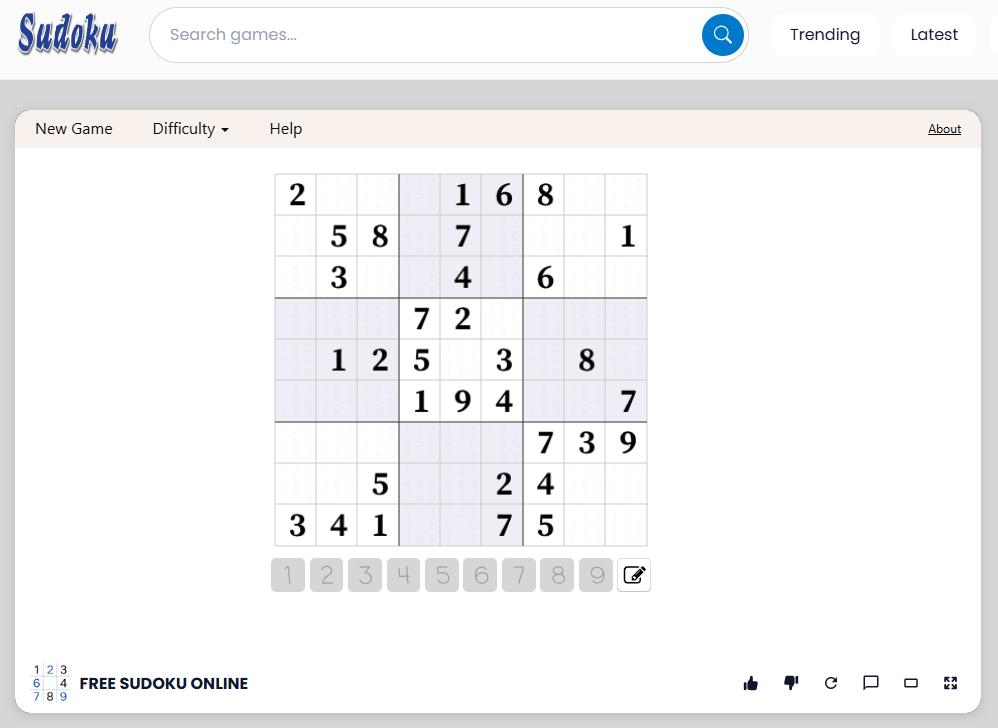
Sudoku is one of the most popular number puzzles in the world. Simple rules, a clear grid, and logical challenges make Sudoku suitable for beginners and experienced puzzle players. Although Sudoku uses numbers, it does not require advanced mathematics. The main challenge comes from observation, deduction, concentration, and careful decision-making.
Today, Sudoku appears in newspapers, puzzle books, websites, and mobile applications. Players can enjoy a quick puzzle during a short break or spend more time solving difficult grids. Understanding how Sudoku works can make the game more enjoyable while also helping players develop useful thinking habits.
What Is Sudoku?
Sudoku is a logic-based puzzle played on a 9 × 9 grid. The complete grid contains 81 cells divided into nine smaller 3 × 3 boxes. The objective is to fill every empty cell with a number from 1 to 9.
Each number can appear only once in every row, column, and 3 × 3 box. The puzzle begins with several numbers already placed on the grid. These starting numbers provide clues that guide the solving process.
Sudoku does not depend on calculation. Instead, players examine the available numbers and determine which values can legally fit into empty cells. Every placement should follow the rules of the grid.
The Basic Sudoku Rules
The rules of standard Sudoku are easy to understand. Each row must contain the numbers 1 through 9 without repetition. Each column must also contain the numbers 1 through 9 without repetition. The same requirement applies to each 3 × 3 box.
A number that already appears in a particular row cannot be placed in another empty cell within that row. The same principle applies to columns and boxes. By repeatedly checking these restrictions, players can gradually discover the correct numbers.
These simple rules create a surprisingly deep puzzle. A single correct number can reveal new possibilities elsewhere on the grid, allowing the solving process to continue.
How to Solve Sudoku for Beginners
Learning how to solve Sudoku becomes easier when the grid is approached systematically. Beginners should avoid guessing whenever possible. Instead, logical elimination can reveal many answers.
Start by examining rows, columns, and boxes that already contain many numbers. These areas usually have fewer empty cells, which makes potential answers easier to identify.
Look for Missing Numbers
One of the easiest techniques is to identify missing numbers in a row, column, or box. Suppose a row contains eight numbers and only one cell remains empty. The missing number must be placed in that cell.
This technique is simple but important because it introduces the basic principle of Sudoku solving: every placement should come from information already available on the grid.
Use Candidate Numbers
When an empty cell cannot be solved immediately, players can consider possible candidates. A candidate is a number that does not conflict with the existing numbers in the same row, column, or box.
For example, if a cell cannot contain 2, 4, 6, 7, or 9, the remaining candidates may be 1, 3, 5, or 8. Further examination of nearby cells can eventually eliminate more candidates.
Writing down possible candidates can make difficult puzzles easier to organize. It also reduces the risk of forgetting useful information during a long solving session.
Search for Hidden Opportunities
Sometimes a number can fit in several cells within a row, but only one of those cells is located inside a particular box. This type of relationship can provide an important clue.
Players can compare rows with boxes and columns with boxes to find restricted positions. Careful scanning often reveals answers that are not obvious from looking at one area alone.
Why Sudoku Is Good for the Mind
Sudoku provides more than entertainment. The solving process encourages players to concentrate on details, compare possibilities, and make decisions based on logical evidence.
A Sudoku puzzle can also encourage patience. Difficult grids rarely reveal every answer immediately. Players need to continue examining the board, reconsider possibilities, and work through problems step by step.
Sudoku and Logical Thinking
Logical reasoning is central to Sudoku. Players constantly ask questions such as which numbers are possible, which numbers are impossible, and which placement creates a clear consequence elsewhere.
This process can strengthen structured thinking habits. Instead of relying on random choices, players learn to use available evidence before making a decision.
Sudoku and Concentration
A Sudoku grid contains many small details. Losing track of one number can lead to mistakes later in the puzzle. Regular play therefore encourages sustained attention.
Short Sudoku sessions can provide a focused activity away from social media, entertainment content, or other distractions. The simple visual structure of the grid allows players to concentrate on one clearly defined task.
Different Levels of Sudoku Difficulty
Sudoku puzzles are available in many difficulty levels. Easy puzzles usually provide more starting numbers and contain straightforward solutions. These puzzles are useful for people who are learning the basic rules.
Medium puzzles require more careful candidate analysis and interaction between different parts of the grid. Hard puzzles can involve advanced logical techniques and require considerably more patience.
Easy Sudoku
Easy Sudoku is an excellent starting point for beginners. Many answers can be found by scanning rows, columns, and boxes for missing numbers.
The main goal at this stage is to become comfortable with the rules and develop a consistent solving method.
Medium and Hard Sudoku
More difficult puzzles contain fewer obvious answers. Players need to track candidates and recognize relationships between cells.
Advanced solving may involve techniques such as naked pairs, hidden pairs, pointing pairs, and box-line interactions. These methods help players eliminate candidates without making random guesses.
Tips for Better Sudoku Solving
A consistent approach can make Sudoku faster and more enjoyable. Begin with the areas that have the most numbers already filled in. Then move systematically through rows, columns, and boxes.
Avoid placing a number simply because it seems likely. Before confirming a placement, check the relevant row, column, and box.
When progress stops, move to another section of the grid instead of repeatedly examining the same cells. A new discovery in another area may provide the information needed to continue.
It is also useful to review the entire grid after making several placements. New numbers often create opportunities that were not available earlier.
Sudoku as a Daily Puzzle Habit
Sudoku can easily become part of a daily puzzle routine. A single grid may take only a few minutes, while a challenging puzzle can provide a longer mental activity.
Daily Sudoku practice can also make familiar solving patterns easier to recognize. As players gain experience, they may begin to identify useful relationships between cells without consciously checking every possibility.
The appeal of Sudoku comes from this combination of simplicity and depth. The rules remain the same, but every puzzle creates a different logical challenge.
Conclusion
Sudoku is a simple number puzzle built around powerful ideas of logic, deduction, and concentration. The objective is easy to understand: fill a 9 × 9 grid so that every row, column, and 3 × 3 box contains the numbers 1 through 9 without repetition.
For beginners, the best approach is to start with obvious missing numbers, use candidate numbers, and gradually learn more advanced techniques. With regular practice, solving Sudoku can become faster, more organized, and more rewarding.
Whether played on paper or online, Sudoku offers an accessible way to enjoy a focused mental challenge. Its simple structure, flexible difficulty, and satisfying solving process explain why Sudoku continues to attract puzzle fans around the world.

 English
