
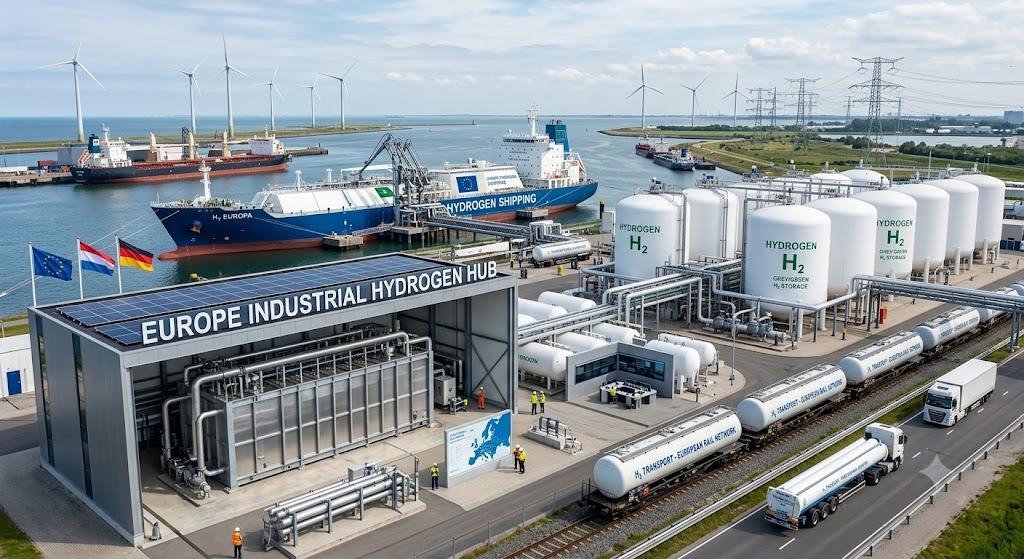
Europe Industrial Hydrogen Market: Emerging Demand Across Heavy Industry
Hydrogen demand in Europe is entering a period of diversification. Traditional consumers such as refineries, fertilizer manufacturers, and chemical producers remain important, while steel, synthetic fuels, mobility, and other industrial applications are exploring new opportunities. This broader demand base could strengthen the industrial hydrogen ecosystem and create new requirements for production, infrastructure, storage, and certification.
Existing industrial users provide a logical starting point for clean hydrogen adoption. Many facilities already rely on hydrogen produced from fossil fuels, so replacing conventional supply with lower carbon alternatives can reduce emissions without completely redesigning the underlying process. However, the economics still depend on hydrogen prices, power costs, equipment availability, infrastructure, and the value customers place on lower emissions.
Steelmaking represents another potentially significant demand segment. Hydrogen can act as a reducing agent in direct reduced iron processes, offering an alternative to conventional coal based production routes. New hydrogen based steel facilities require substantial capital and reliable energy supplies, but they can support deeper industrial decarbonization. Their development may also encourage nearby renewable power and hydrogen infrastructure investment.
The chemical sector can provide additional opportunities. Hydrogen is used directly in ammonia, methanol, and other chemical processes. Cleaner hydrogen can reduce the emissions associated with these products, while hydrogen derivatives can support new downstream applications. Integration between hydrogen producers and chemical manufacturers can improve utilization and create more predictable demand.
Synthetic fuels may further expand the market. Hydrogen combined with captured carbon can contribute to the production of certain low carbon fuels and chemicals. Aviation and maritime applications are particularly relevant because direct electrification can be challenging for long distance operations. These emerging markets could create additional hydrogen demand, although economics and feedstock availability remain important considerations.
Industrial demand is also connected to geography. Large consumers tend to cluster around ports, chemical parks, refining centers, and manufacturing regions. Locating production near these demand centers can reduce transportation costs and simplify supply relationships. Where local renewable resources are limited, pipeline networks or imported derivatives may provide alternative supply routes.
According to the Europe Industrial Hydrogen Industry, future demand will depend on industrial decarbonization policies, project economics, infrastructure development, technology progress, and customer willingness to adopt hydrogen.
Certification is becoming increasingly important as buyers seek evidence of emissions performance. Industrial customers may need to demonstrate that hydrogen meets specific sustainability or carbon intensity requirements. Transparent tracking systems can help establish trust between producers and consumers while supporting regulatory compliance.
Procurement strategies are evolving as well. Some companies may prefer long term supply agreements, while others could combine contracted volumes with market purchases. Renewable power procurement can also be integrated into hydrogen strategies, particularly for producers operating dedicated electrolysis facilities. The right structure will depend on consumption patterns, risk tolerance, and local market conditions.
Manufacturing facilities often operate continuously and cannot easily tolerate supply interruptions. Hydrogen projects must therefore consider redundancy, storage, maintenance schedules, backup supply, and network resilience. These factors can influence purchasing decisions as much as headline production cost.
The future industrial hydrogen landscape is likely to be diverse rather than dominated by one application. Established consumers can anchor early demand, while steel, chemicals, fuels, and other emerging uses can support longer term expansion. Europe's opportunity lies in building a demand base that is commercially sustainable.

 Russian
