
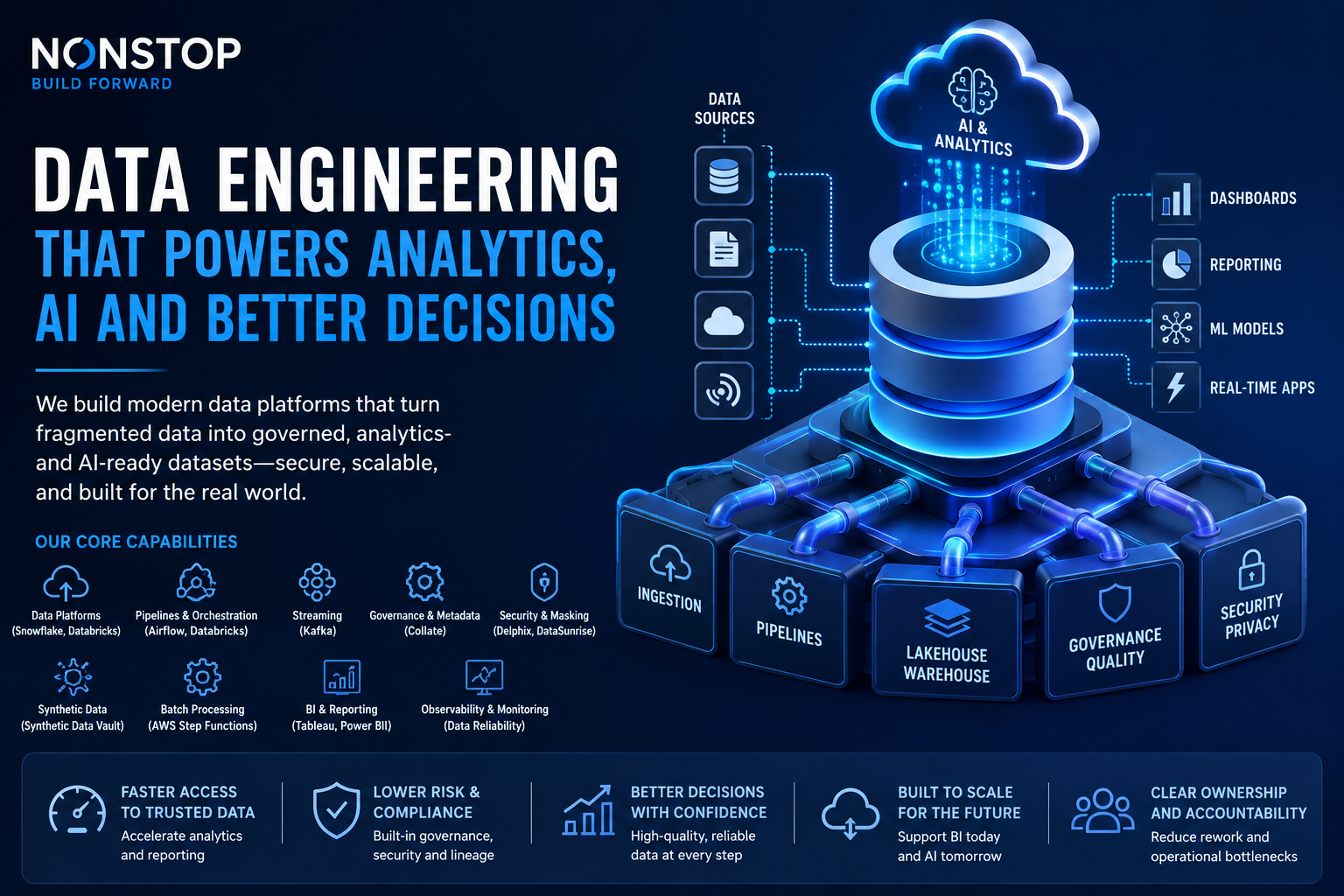
Modern organizations generate data from applications, cloud systems, databases, customer platforms, IoT devices, and business operations. The challenge is no longer simply collecting that data. The real challenge is making it reliable, governed, secure, and ready to use.
When data is scattered across disconnected systems, teams often spend more time cleaning, validating, and moving information than actually using it. This can slow down reporting, create inconsistencies between teams, and make it harder to build dependable AI and analytics solutions.
That is where modern data engineering becomes important. A well-designed data platform connects different sources, manages data through reliable pipelines, applies governance and security controls, and delivers trusted datasets for analytics, business intelligence, and machine learning.
What Is Data Engineering?
Data engineering is the process of designing, building, and maintaining the infrastructure that allows organizations to collect, transform, store, govern, and deliver data.
A modern data engineering environment can include:
- Data warehouses
- Data lakes and lakehouses
- Batch processing pipelines
- Real-time streaming
- Data transformation
- Data governance
- Data quality monitoring
- Data security and masking
- Business intelligence systems
- Analytics and machine learning infrastructure
The goal is straightforward: make the right data available to the right people and systems in a reliable and secure way.
Why Organizations Need Modern Data Engineering
Legacy data environments often evolve over many years. Different teams may use different databases, applications, reporting tools, and storage systems. Over time, this can create duplicated data, inconsistent definitions, manual processes, and difficult integrations.
A modern data platform helps bring these environments together.
Instead of relying on disconnected pipelines and spreadsheets, organizations can establish a structured architecture where data moves through defined stages:
Source → Ingestion → Transformation → Storage → Governance → Analytics → AI
This approach creates a stronger foundation for both current reporting requirements and future AI initiatives.
Data Platform Architecture and Roadmapping
Successful data projects usually begin with architecture rather than technology selection.
A data engineering team first needs to understand:
- Where data currently lives
- How data is generated
- Which systems need to communicate
- What data needs to be retained
- Who needs access
- What compliance requirements apply
- Which analytics and AI use cases are expected
- How the platform needs to scale
From there, organizations can create a roadmap covering ingestion, storage, transformation, governance, analytics, and AI.
A well-planned architecture can also prevent organizations from rebuilding their data infrastructure every time a new business requirement appears.
Data Warehouse and Lakehouse Engineering
Organizations often need centralized environments where large volumes of structured and unstructured information can be analyzed efficiently.
Data warehouses provide structured environments for analytics and reporting, while lakehouses combine characteristics of data lakes and warehouses.
Platforms such as Snowflake and Databricks can support scalable analytical workloads while allowing organizations to manage large and diverse datasets.
The right architecture depends on the organization's data volume, workloads, security requirements, existing infrastructure, and long-term goals.
Building Reliable Data Pipelines
Data pipelines are the backbone of a modern data platform.
They move information from source systems into analytical environments while applying transformations and validation rules along the way.
Pipelines can support:
- Batch data processing
- Scheduled ingestion
- Data transformation
- Data validation
- Workflow dependencies
- Error handling
- Automated retries
- Data delivery
Tools such as Apache Airflow and Databricks can help orchestrate these workflows and make complex data processes easier to manage.
The objective isn't simply to move data. It is to make sure the data arrives consistently and reliably.
Real-Time Data Streaming
Not every business decision can wait for an overnight data refresh.
Real-time data streaming allows organizations to process events as they occur. This can be useful for applications such as:
- Real-time dashboards
- Fraud detection
- Operational monitoring
- Alerts
- Event-driven applications
- Customer activity analysis
Technologies such as Apache Kafka, Amazon Kinesis, and Apache Flink can support streaming architectures where data needs to move continuously through the platform.
For organizations with time-sensitive workloads, streaming can become an important part of the overall data architecture.
Data Governance and Data Quality
Having more data does not automatically create better decisions.
If teams cannot determine where data came from, whether it is accurate, or who is responsible for it, confidence in analytics quickly declines.
Data governance establishes processes and controls around:
- Data ownership
- Metadata
- Lineage
- Access control
- Data quality
- Retention
- Compliance
- Documentation
Data quality practices can also monitor issues such as missing values, unexpected changes, duplicate records, and inconsistent formats.
Together, governance and quality controls help organizations create datasets that teams can trust.
Data Security, Privacy, and Masking
Data platforms frequently contain sensitive business or personal information. Security therefore needs to be part of the architecture rather than an afterthought.
Modern data engineering environments can incorporate:
- Role-based access
- Data masking
- Encryption
- Secure environments
- Audit trails
- Privacy controls
- Controlled test datasets
Tools such as Delphix and DataSunrise can support data masking and privacy requirements in appropriate environments.
For regulated industries, security and governance are especially important when data is used for analytics, testing, or AI development.
Synthetic Data for Testing and AI
Using production data for development and testing can introduce privacy and security concerns.
Synthetic data provides another option by generating artificial datasets that resemble characteristics of real data without exposing the underlying production records.
Synthetic data can support:
- Software testing
- Data pipeline development
- Model training
- Development environments
- Analytics experimentation
Solutions such as Synthetic Data Vault and Tonic.ai can be incorporated into data workflows where synthetic datasets are appropriate.
Making Data Ready for Analytics and BI
A data platform should ultimately make information easier for business teams to use.
Clean, governed datasets can feed business intelligence platforms such as Tableau and Microsoft Power BI.
Instead of analysts repeatedly extracting and cleaning raw information, the data engineering layer can provide standardized datasets designed for reporting and analysis.
This can help organizations improve:
- Dashboard reliability
- Reporting speed
- Data consistency
- Decision-making
- Self-service analytics
The result is a clearer connection between technical data infrastructure and business outcomes.
Data Observability and Reliability
A pipeline can technically be running while still producing bad results.
For example, a pipeline may complete successfully but deliver incomplete data, unexpected volumes, outdated records, or a changed schema.
Data observability helps teams monitor the health of data systems by tracking areas such as:
- Freshness
- Volume
- Schema changes
- Pipeline failures
- Data quality
- Delivery status
This makes it easier to detect problems before they affect business dashboards, reports, or downstream AI systems.
Data Engineering for AI and Machine Learning
AI systems are only as useful as the data supporting them.
Machine learning and generative AI initiatives often require large volumes of well-structured, accessible, and properly governed information.
A strong data engineering foundation can support:
- Feature engineering
- Training datasets
- ML pipelines
- Data preparation
- Model monitoring
- Analytics
- Retrieval workflows
- AI-ready data products
This is why data engineering increasingly sits alongside AI and machine learning rather than operating as a completely separate function.
Data Engineering for Specialized Industries
Different industries have different data requirements.
Healthcare and life sciences, for example, may need to manage clinical, genomic, laboratory, and patient data while maintaining strict privacy and governance controls.
In these environments, the data platform may need to connect with bioinformatics pipelines, clinical systems, analytics platforms, and AI applications.
For genomic and healthcare organizations, a governed data architecture can provide the foundation for advanced analytics and AI-driven applications.
What Organizations Can Achieve With Better Data Engineering
A well-designed data platform can create several practical improvements.
Faster Access to Trusted Data
Standardized and governed datasets reduce the amount of time teams spend validating and preparing information before analysis.
Less Data Firefighting
Reliable pipelines and observability help teams identify failures and data quality issues earlier.
Better Decision-Making
Consistent and well-managed data improves confidence in dashboards, reports, forecasts, and analytical models.
Lower Operational Risk
Security, governance, lineage, and monitoring can reduce risks associated with poorly controlled data environments.
A Foundation for Future AI
An architecture designed for scalability can support analytics today while providing infrastructure for machine learning and AI tomorrow.
Choosing the Right Data Engineering Approach
There is no single architecture that works for every organization.
The right approach depends on factors such as:
- Data volume
- Data sources
- Real-time requirements
- Existing technology stack
- Security requirements
- Compliance obligations
- Analytics workloads
- AI use cases
- Budget
- Internal engineering capabilities
Organizations should avoid selecting technologies simply because they are popular. The architecture should solve actual business and technical problems.
Building a Scalable Data Foundation
Data engineering is no longer just about creating ETL pipelines. Modern data platforms need to support the complete lifecycle of organizational data, from ingestion and storage through governance, analytics, and AI.
With the right architecture, organizations can move from fragmented information to a reliable data environment that supports everyday reporting as well as more advanced use cases.
At NonStop, data engineering services focus on building production-grade data platforms across cloud, analytics, AI, and enterprise environments. The approach covers data architecture, warehouses and lakehouses, pipeline orchestration, streaming, governance, security, synthetic data, analytics, and observability.
The ultimate goal is simple: turn fragmented data into a scalable foundation for better decisions, analytics, and AI.

 English
