
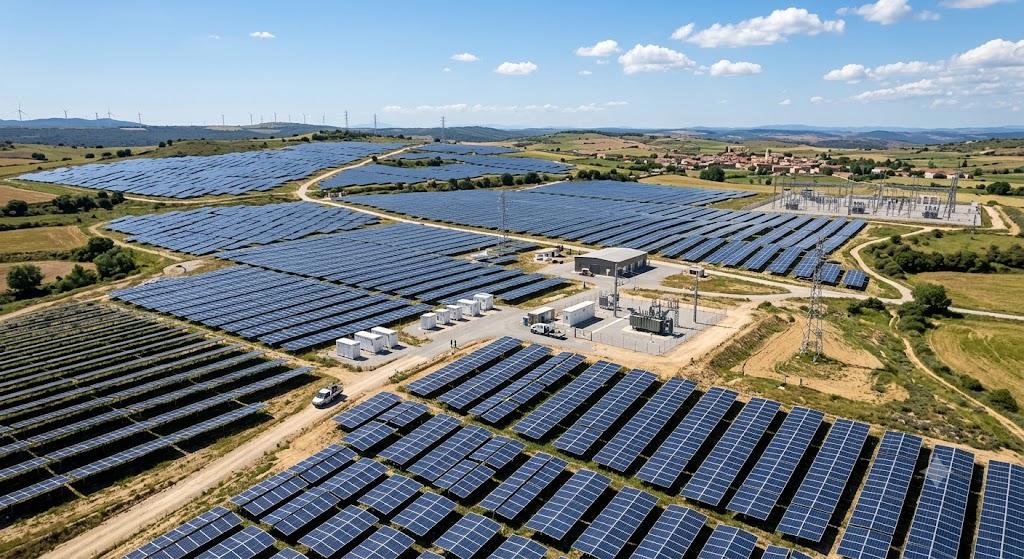
Europe Utility-Scale Solar PV Market: Policy, Auctions, and PPA Dynamics
Europe’s utility-scale solar expansion is being shaped by a combination of climate policy, electricity demand, investment appetite, and increasingly complex power-market conditions. Large solar projects remain important for meeting renewable targets, yet developers face a different challenge from earlier market cycles: securing projects that can remain profitable when grid constraints and volatile price patterns affect revenue.
Government policy continues to provide a foundation for development. Renewable targets, permitting reforms, and national auctions can accelerate deployment and improve revenue visibility. Auction design, eligibility, contract duration, indexation, and settlement rules influence project attractiveness. National differences mean that a successful strategy in one market cannot automatically be replicated elsewhere.
Permitting acceleration can reduce development timelines, but implementation depends on authorities, local resources, environmental reviews, and grid coordination. Faster permitting does not create faster projects when grid studies or reinforcement remain unresolved.
Auctions can improve bankability when they provide predictable revenue, but competition must be considered. Aggressive bidding may reduce project margins, particularly if equipment, financing, or construction costs change after award. Developers need disciplined assumptions before committing to a price.
Power purchase agreements are becoming another major route to market. Corporate and utility buyers can provide long-term demand for renewable electricity. PPA negotiations increasingly focus on risk allocation. Pricing formulas, generation profiles, imbalance exposure, curtailment clauses, guarantees, and termination provisions can influence financing as much as headline price.
Merchant exposure remains possible where power markets offer attractive volatility and flexible operations. However, increasing solar penetration can weaken daytime capture rates. Projects with merchant tails require sophisticated forecasting and downside testing. Storage, hedging, or structured offtake can diversify revenue.
The Europe Utility-Scale Solar PV Market Trends outlook highlights the growing importance of revenue quality alongside deployment. The market is not simply expanding through additional capacity; it is evolving toward projects designed around grid conditions, contracting structures, and flexibility needs. This makes policy analysis inseparable from commercial analysis.
Grid investment is particularly important for the next phase. Grid upgrades must keep pace with renewable development to reduce congestion and enable dispatch. Constrained networks may cause curtailment or delayed connections. Grid evidence in site selection can reduce these risks.
Policy differences also create geographic opportunities. Southern European markets benefit from strong solar resources and established renewable pipelines. Western European markets can offer sophisticated PPA ecosystems and industrial demand. Central and Eastern European markets may provide development potential as renewable targets and infrastructure evolve. Northern markets bring different seasonal conditions and system requirements.
Competition is becoming more strategic. Developers need capabilities spanning land acquisition, permitting, grid studies, financing, contracting, construction, and operations. Efficient interface management can improve project economics. EPC providers and technology suppliers can also differentiate through grid-compliance expertise, digital controls, and flexible plant designs.
Investors are increasingly examining policy durability rather than simply counting announced targets. A credible project needs a realistic path from permitting to connection, construction, commissioning, and revenue generation. Stress testing should consider delays, price changes, curtailment, and contract performance. These factors determine whether projected returns can withstand real operating conditions.
Over the next several years, successful European utility-scale solar projects will likely combine supportive policy with commercial discipline. Auctions may remain important, but PPAs, hybridization, and market-based structures will expand the range of financing options. The strongest developers will select revenue models according to project location and system conditions rather than applying a uniform strategy.
Europe’s solar market therefore offers substantial opportunity, but policy signals must be interpreted alongside power-market realities. Investors, developers, and buyers that understand how support schemes, grid constraints, contracting, and price behavior interact will be better positioned to identify durable projects. The next phase of utility-scale solar will reward execution quality, adaptable commercial structures, and evidence-based project selection.

 English
