
Healthcare is rapidly embracing precision medicine, where treatment decisions are guided by an individual's unique genetic profile rather than a one-size-fits-all approach. Among the most impactful advances is pharmacogenomics, which helps clinicians understand how a patient's genes influence their response to medications.
A modern Pharmacogenomics Platform enables clinical laboratories and health systems to move beyond simply generating genetic test results. It transforms genomic data into actionable prescribing recommendations by integrating variant analysis, clinical guidelines, and real-time decision support directly into existing healthcare workflows.
Why Pharmacogenomics Is Changing Modern Healthcare
Every patient metabolizes medications differently. Variations in pharmacogenes such as CYP2D6, CYP2C19, CYP2C9, SLCO1B1, DPYD, TPMT, and many others can affect drug safety and effectiveness.
Instead of relying on trial-and-error prescribing, pharmacogenomics allows clinicians to make informed medication choices based on a patient's genetic profile, helping improve treatment outcomes while reducing the risk of adverse drug reactions.
From Genetic Testing to Clinical Action
Generating sequencing data is only one part of the pharmacogenomics workflow. The real value comes from translating genetic findings into clinically meaningful prescribing guidance.
A complete pharmacogenomics solution connects laboratory testing, genomic interpretation, clinical evidence, healthcare interoperability, and provider workflows into one streamlined platform.
Accurate PGx Variant Calling and Star Allele Determination
Reliable pharmacogenomic reporting begins with accurate genetic interpretation.
The platform supports CPIC-aligned star allele determination for major pharmacogenes including:
- CYP2D6
- CYP2C19
- CYP2C9
- SLCO1B1
- DPYD
- TPMT
- More than 50 additional pharmacogenes
The platform processes data from:
- Targeted pharmacogenomics panels
- Whole Genome Sequencing (WGS)
- SNP genotyping arrays
Diplotype assignment and phenotype determination help generate standardized reports that clinicians can confidently use during prescribing decisions.
Evidence-Based Drug-Gene Interpretation
Clinical recommendations require more than genetic data alone.
The integrated knowledge base combines trusted pharmacogenomic resources, including:
- CPIC prescribing guidelines
- PharmGKB drug-gene annotations
- Drug-specific prescribing recommendations
- Metabolizer phenotype interpretation
- Updated clinical evidence
This allows healthcare providers to access consistent, evidence-based prescribing guidance as new recommendations become available.
Delivering Real-Time Clinical Decision Support
One of the greatest strengths of pharmacogenomics is providing actionable insights exactly when clinicians need them.
The platform delivers real-time prescribing support during medication ordering through:
- Medication alerts
- Dose adjustment recommendations
- Alternative therapy suggestions
- Configurable phenotype rules
- Clinical context-based alert logic
Rather than requiring providers to search through laboratory reports, prescribing guidance appears within existing clinical workflows, improving efficiency while supporting informed decision-making.
Seamless FHIR EHR Integration for Clinical Workflows
Successful pharmacogenomics programs depend on interoperability.
The platform supports seamless integration with healthcare systems using modern standards including:
- FHIR R4 Observations
- HL7 v2 messaging
- CDS Hooks
- Epic BPA and App Orchard
- Cerner Ignite API
- PowerPlan integration
Pharmacogenomic results are stored as structured FHIR observations, allowing providers to review genomic findings and prescribing recommendations directly within their electronic health record without switching between multiple systems.
Correlating Genetic Results with Medication History
Medication history often provides valuable clinical insight.
The platform correlates genetic variants with:
- Current medications
- Historical prescriptions
- Previous adverse drug reactions
- Existing pharmacogenomic profiles
By identifying potential gene-drug interactions based on both current and past medications, clinicians gain additional context before prescribing future therapies.
Integrated Laboratory and Clinical Genomics Workflows
A pharmacogenomics program extends well beyond sequencing.
The platform integrates with laboratory and clinical systems including:
- Laboratory Information Management Systems (LIMS)
- Sample tracking
- Test order management
- Clinical genomics platform
- HL7 v2 ORU reporting
- FHIR DiagnosticReport delivery
This creates an efficient workflow from laboratory processing through clinical reporting and provider review.
Built on Standards That Support Interoperability
Healthcare organizations require platforms that integrate with existing infrastructure rather than replacing it.
The technical architecture supports:
- HIPAA-compliant genomics infrastructure
- FHIR-native data storage
- HL7 messaging
- CDS Hooks
- Epic integration
- Cerner integration
These standards enable secure data exchange between laboratories, EHRs, clinical decision support systems, and patient-facing applications.
Supporting Compliance and Clinical Governance
Clinical genomics requires robust governance and regulatory compliance.
The platform includes:
- HIPAA-compliant data architecture
- CPIC guideline-aligned interpretation
- PharmGKB integration
- CAP/CLIA-compliant reporting
- Complete audit trails for PGx results and CDS events
This helps laboratories and health systems maintain compliance while delivering reliable pharmacogenomic reporting.
Connected Across the Clinical Genomics Ecosystem
Pharmacogenomics is most effective when integrated into a broader precision medicine environment.
The platform works alongside:
Clinical Genomics Platform
Supporting unified reporting across:
- Whole Exome Sequencing (WES)
- Whole Genome Sequencing (WGS)
- Targeted sequencing panels
- Pharmacogenomic testing
Patient & Provider Portal
Patients and clinicians can securely access:
- Pharmacogenomic reports
- Medication guidance
- Genetic counseling scheduling
- Patient result delivery
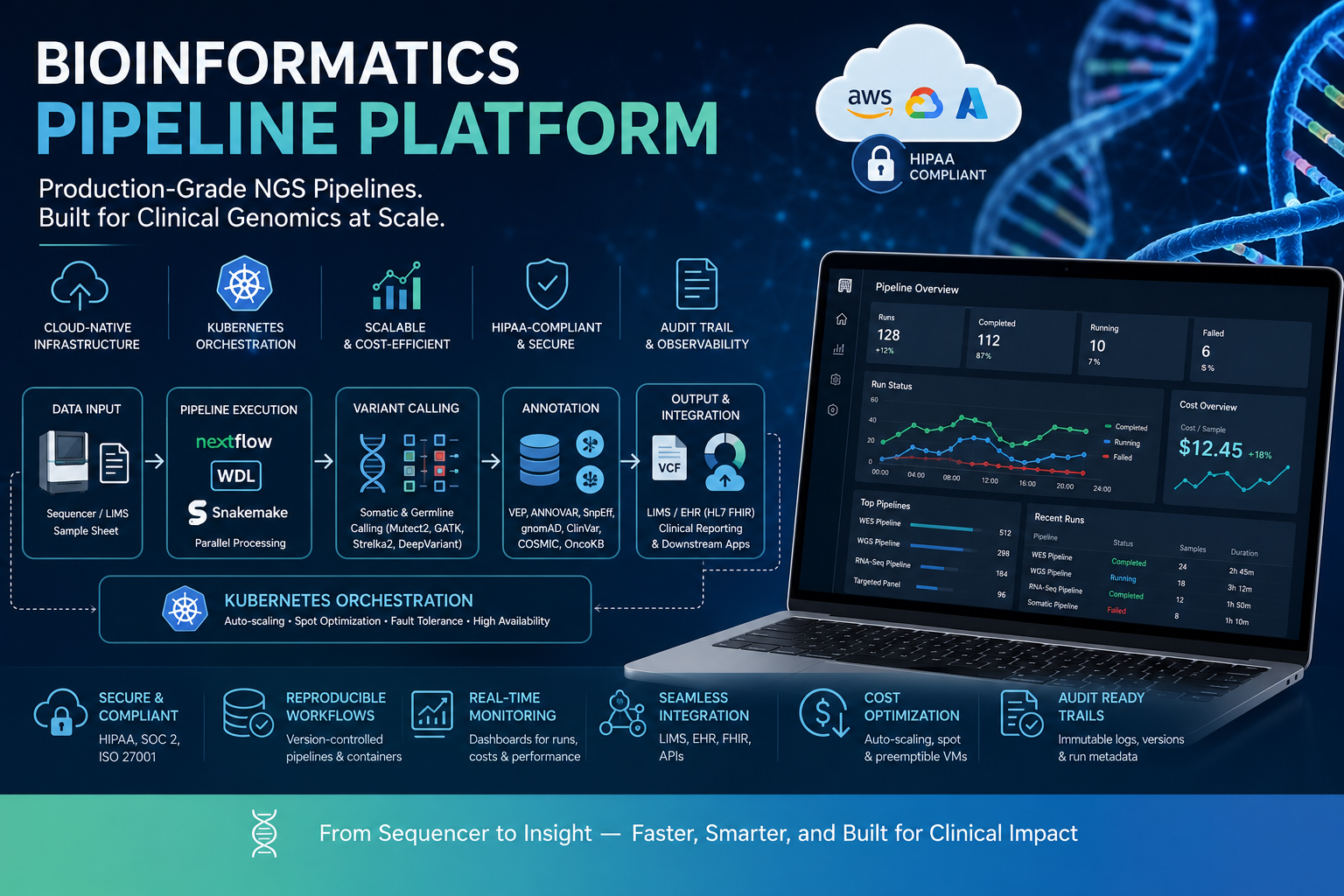
Bioinformatics Pipeline Platform
Automated upstream workflows support:
- PGx panel sequencing
- Variant calling
- Star allele determination
- Report generation
- Workflow automation
Together, these connected platforms create an end-to-end precision medicine ecosystem that supports both laboratories and healthcare providers.
Why Health Systems Are Investing in Pharmacogenomics
As precision medicine becomes part of routine clinical practice, pharmacogenomics is helping organizations improve prescribing decisions while integrating genomic insights directly into everyday care.
Key benefits include:
- Personalized prescribing recommendations
- Reduced risk of adverse drug reactions
- Faster clinical decision-making
- Improved healthcare interoperability
- Scalable precision medicine programs
- Better integration across laboratory and clinical workflows
Conclusion
A modern Pharmacogenomics Platform helps transform genetic testing into meaningful clinical action. By combining accurate variant interpretation, evidence-based prescribing guidance, healthcare interoperability, and integrated clinical workflows, healthcare organizations can support safer and more personalized medication decisions.
For clinical laboratories and health systems expanding precision medicine programs, a pharmacogenomics platform provides the technology foundation needed to deliver actionable genomic insights while integrating seamlessly with existing laboratory and healthcare ecosystems.

 Russian
