
Building software for healthcare, clinical laboratories, and genomics is rarely as simple as writing requirements, developing features, and handing over the finished product.
The hardest problems often appear when software meets real workflows.
A laboratory may have an existing LIMS, an EHR, sequencing pipelines, compliance requirements, and years of operational data. A healthcare organization may need FHIR and HL7 interoperability without disrupting clinical workflows. A genomics team may need to move an AI model from a promising prototype into a production environment where accuracy, traceability, security, and human oversight all matter.
This is where the forward-deployed engineer model becomes valuable.
Instead of working from the outside and delivering a specification or prototype, forward-deployed engineers work directly with the customer’s team and environment. They understand the problem, build the system, integrate it with existing infrastructure, and remain involved until the solution is actually working in production.
For organizations working in genomics and healthcare technology, that difference can be significant.
What Is a Forward-Deployed Engineer?
A forward-deployed engineer is a software engineer who works closely with a customer’s real environment rather than operating entirely from a remote product or consulting team.
The engineer may work remotely, in a hybrid setup, or on-site depending on the engagement and requirements.
The important part is not the location. It is the level of involvement.
A traditional software engagement may look something like this:
Requirements → Design → Development → Handoff
A forward-deployed model is closer to:
Understand → Embed → Build → Integrate → Test → Deploy → Improve
The engineer stays close to the people using the system and the technical environment in which it needs to operate.
That can be especially important for clinical and genomics projects because many requirements cannot be fully understood from documentation alone.
A workflow that looks straightforward on paper may involve laboratory technicians, bioinformaticians, clinical reviewers, compliance teams, physicians, and IT administrators.
An embedded engineer gets to see those interactions firsthand.
Why Healthcare and Genomics Need a Different Engineering Model
Healthcare software has an unusual combination of technical and operational complexity.
A genomics platform, for example, may need to connect:
- Sequencing instruments
- Bioinformatics pipelines
- Variant databases
- LIMS platforms
- EHR systems
- Clinical reporting systems
- Patient portals
- Cloud infrastructure
- Authentication and access controls
- Compliance and audit systems
The challenge is not simply building each component.
The challenge is making everything work together reliably.
A genomics software development team also needs to understand domain-specific concepts such as variant interpretation, ACMG/AMP guidelines, sequencing workflows, clinical reporting, and the distinction between research and clinical environments.
That is why domain knowledge can make a major difference.
Embedded Engineering Starts With the Workflow
One of the biggest advantages of forward-deployed engineering is that development starts with the actual workflow rather than assumptions about the workflow.
Imagine a genetic testing laboratory that wants to modernize its sample-to-report process.
The technical requirements may include:
- Automating sample intake
- Connecting the LIMS
- Managing sequencing data
- Triggering bioinformatics pipelines
- Moving variant results into interpretation workflows
- Generating clinical reports
- Sending results to downstream systems
- Maintaining audit trails
But the real requirements may only become obvious when engineers observe how laboratory staff actually perform these tasks.
Where do manual steps happen?
Where do users copy information between systems?
Where do errors occur?
Which approvals require human review?
Which steps create delays?
Which parts of the workflow cannot be changed because of regulatory or operational requirements?
An embedded engineering team can answer those questions while building the solution.
Building Instead of Just Advising
There is a major difference between telling a healthcare organization how a system should work and actually building that system.
A forward-deployed engineer participates in implementation.
That means writing production code, integrating APIs, configuring infrastructure, connecting data sources, testing workflows, troubleshooting failures, and working with the customer’s technical team.
For a genomics organization, that could involve technologies such as Nextflow, GATK, FHIR R4, HL7 v2, cloud infrastructure, databases, APIs, and clinical systems.
The goal is not to leave behind an architecture diagram.
The goal is to leave behind a working system.
Why Domain Expertise Matters in Genomics
Genomics is not a domain where a development team can always learn the terminology after the project begins.
A team working on a clinical genomics platform may encounter:
- ACMG/AMP variant classification
- Germline and somatic workflows
- WES and WGS data
- Variant annotation
- Bioinformatics pipelines
- Clinical reporting
- FHIR-based interoperability
- LIMS integration
- CAP/CLIA considerations
- HIPAA requirements
A generalist software engineer can learn these concepts, but the learning curve can add significant time and create misunderstandings.
A genomics-native engineering team starts with a better understanding of the environment.
That allows technical decisions to be made with both software architecture and scientific workflows in mind.
Forward-Deployed Engineers and AI Projects
AI projects provide another strong use case for embedded engineering.
Many organizations can build an AI proof of concept.
The difficult part is getting it into production.
A healthcare AI system may need to operate alongside existing clinical workflows, data governance policies, security controls, and human review processes.
Consider an AI-assisted variant interpretation system.
A prototype might successfully produce a classification suggestion.
A production system may additionally need to answer:
- Where did the evidence come from?
- Which model version produced the result?
- What data was used?
- What confidence does the system have?
- Can a clinical reviewer override the recommendation?
- Is the decision recorded?
- Can the result be audited later?
- What happens when new evidence becomes available?
This is where AI implementation in healthcare requires more than a model.
It requires engineering around the model.
A forward-deployed engineer can help connect the AI capability to the operational system surrounding it while keeping appropriate human review in the loop.
From Prototype to Production
One of the biggest gaps in enterprise software is the distance between a successful demonstration and a production-ready system.
A demo can run with a small dataset.
Production needs to handle real users, real data, failures, security requirements, monitoring, integrations, and ongoing maintenance.
Forward-deployed engineering focuses on closing that gap.
For example, a genomics organization may begin with a proof of concept for automated variant interpretation.
The production journey could involve:
- Connecting the system to existing genomic data.
- Integrating evidence sources.
- Building the review workflow.
- Adding user authentication and permissions.
- Recording provenance and audit information.
- Integrating with clinical systems.
- Testing with representative workloads.
- Monitoring system performance.
- Deploying into the organization’s infrastructure.
- Training the internal team to operate the system.
The engineer stays involved throughout that journey rather than stopping when the prototype works.
Working With the Customer's Existing Technology Stack
Healthcare organizations rarely start from scratch.
They already have technology investments that need to remain useful.
A forward-deployed engineering team should therefore be technology agnostic.
Depending on the environment, the work may involve AWS, GCP, Azure, Databricks, Snowflake, Nextflow, GATK, Epic, Cerner, FHIR, HL7, or other technologies.
The objective should not be to replace everything.
It should be to understand the existing environment and integrate where appropriate.
This approach can reduce unnecessary migration work and make adoption easier for internal teams.
The Importance of FHIR and HL7 Integration
Interoperability is one of the biggest considerations when developing healthcare software.
A genomics application may produce valuable information, but that information has limited clinical value if providers cannot access it within their existing workflows.
FHIR and HL7 integration can help connect laboratory and genomic systems with broader healthcare infrastructure.
Depending on the use case, integration may include:
- FHIR R4 resources
- HL7 v2 messaging
- EHR integrations
- Laboratory systems
- Clinical reporting
- Patient-facing applications
Forward-deployed engineers can work directly with the organization’s existing integration architecture and identify where genomic information needs to enter or leave the workflow.
What the Customer Should Own
A successful embedded engineering engagement should not create permanent dependency on the engineering partner.
The customer should ultimately receive a system they can operate and continue developing.
That includes ownership of the software and intellectual property, documentation where appropriate, operational knowledge, and a clear understanding of the architecture.
The ideal outcome is simple:
The engineering team helped build the system, but the customer can confidently run it.
This is particularly important for organizations building strategic technology around clinical genomics because the software becomes part of their long-term infrastructure.
NonStop's Forward-Deployed Engineering Approach
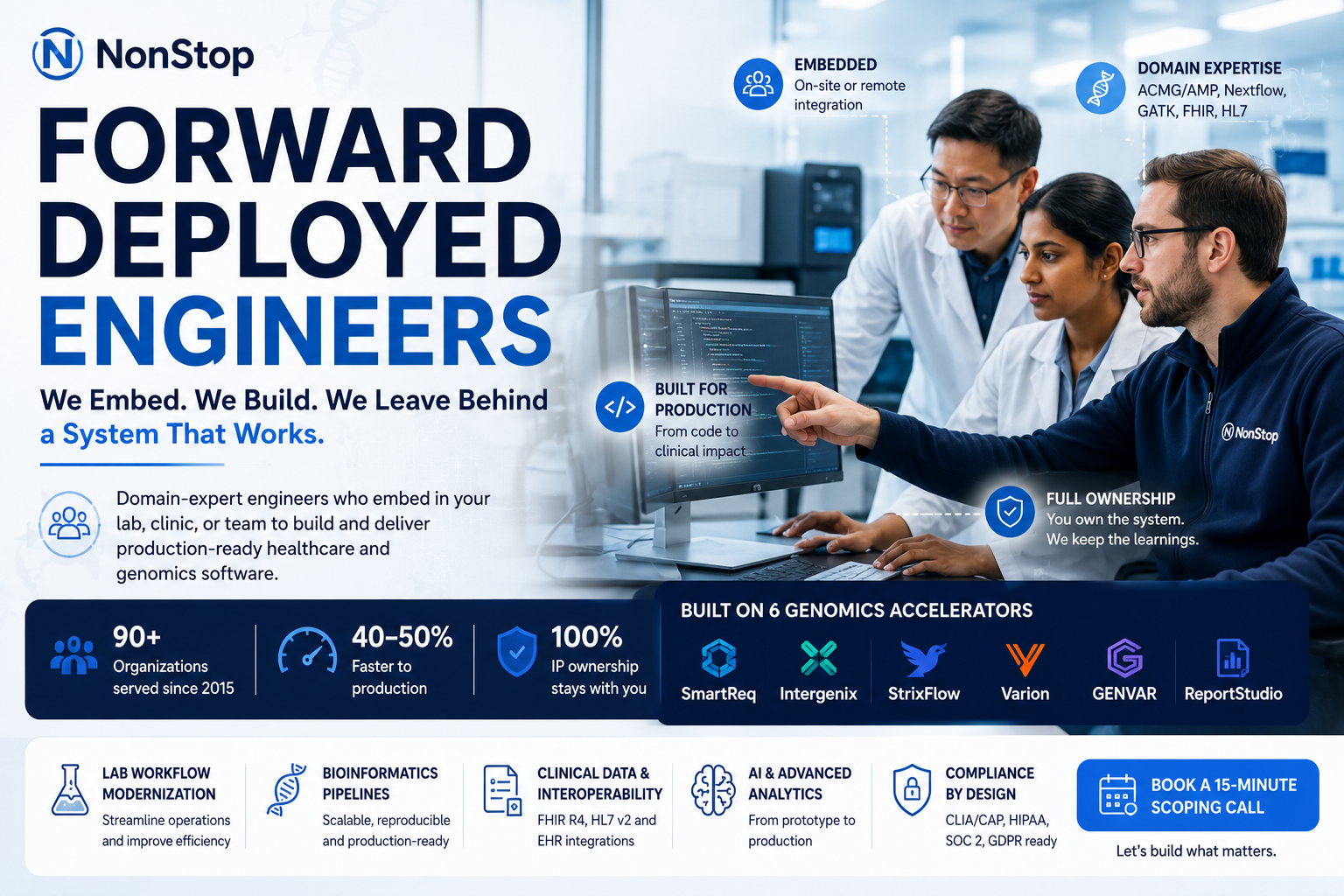
NonStop describes its forward-deployed engineers as engineers who embed directly into laboratory, clinical, or engineering workflows and remain involved through production.
The model combines software engineering with experience across genomics and healthcare technologies.
According to the provided information, NonStop's team works with technologies and standards including ACMG/AMP, Nextflow, GATK, FHIR, and HL7.
The company also describes six genomics accelerators that its engineers can use as starting points rather than building every component from an empty codebase:
- SmartReq
- Intergenix
- StrixFlow
- Varion
- GENVAR
- ReportStudio
The stated objective is to accelerate initial development while allowing the resulting system to be customized around the customer’s environment.
What Does the Customer Get at the End?
The most useful way to evaluate a forward-deployed engineering engagement is to look at the outcome.
A successful engagement should leave behind:
A working production system
Not just a prototype, presentation, or architecture document.
Integration with existing workflows
The software should fit into the systems people already use.
Operational knowledge
The internal team should understand how the system works and how to maintain it.
Ownership
The customer should retain ownership of the system and its intellectual property according to the engagement terms.
A foundation for future development
The system should be designed so the organization can continue improving it as its needs change.
When Should You Consider Forward-Deployed Engineering?
This model may make sense when:
- Your software project involves complex domain workflows.
- Your existing systems need significant integration.
- You have reached the limits of a proof of concept.
- Your internal engineering team lacks specialized genomics expertise.
- You need to modernize a clinical or laboratory workflow.
- Your AI project needs to move from prototype to production.
- You need FHIR or HL7 interoperability.
- Your team needs engineers who can work directly inside your environment.
- The project requires close collaboration between scientists, clinicians, and software engineers.
It may be less appropriate for simple software projects with well-defined requirements and minimal integration.
Forward-Deployed Engineering vs Traditional Consulting
The distinction becomes clearer when comparing the two models.
| Traditional Consulting | Forward-Deployed Engineering |
|---|---|
| Primarily advises | Builds and implements |
| Often works from requirements | Works directly with the workflow |
| May deliver architecture | Delivers working software |
| Handoff can occur after delivery | Stays involved through production |
| Domain expertise varies | Can be specialized around the customer's domain |
| Often project-oriented | Can operate as an extension of the internal team |
Neither model is universally better.
The right choice depends on the project.
But when the challenge is deeply integrated with a customer's workflows, data, infrastructure, and domain requirements, embedded engineering can offer a practical advantage.
The Real Value Is Not the Engineer. It Is the Outcome.
Forward-deployed engineering is sometimes described as a staffing model.
That undersells it.
The real value is the combination of domain knowledge, engineering execution, workflow understanding, and production ownership.
For a genomics laboratory, that might mean modernizing a laboratory workflow.
For a healthcare organization, it could mean integrating genomic results into an EHR.
For a precision medicine company, it could mean turning an AI prototype into a production interpretation system.
The common thread is that the engineering team works close enough to the problem to understand what needs to be built and stays long enough to make sure it actually works.
Final Thoughts
Healthcare and genomics software cannot always be built successfully from a distance.
The systems are interconnected. The workflows are complex. The data is sensitive. Clinical requirements matter. And the difference between a promising prototype and a reliable production platform can be enormous.
That is where the forward-deployed engineering model can make sense.
Instead of simply delivering software and walking away, embedded engineers work alongside the organization, understand the environment, build against real requirements, integrate with existing systems, and stay involved through production.
For organizations developing clinical genomics, healthcare AI, laboratory software, or precision medicine platforms, the question is not simply:
“Who can build this?”
It is:
“Who understands the problem well enough to build it with us and stay until it works?”
That is the problem forward-deployed engineering is designed to solve.

 English
