
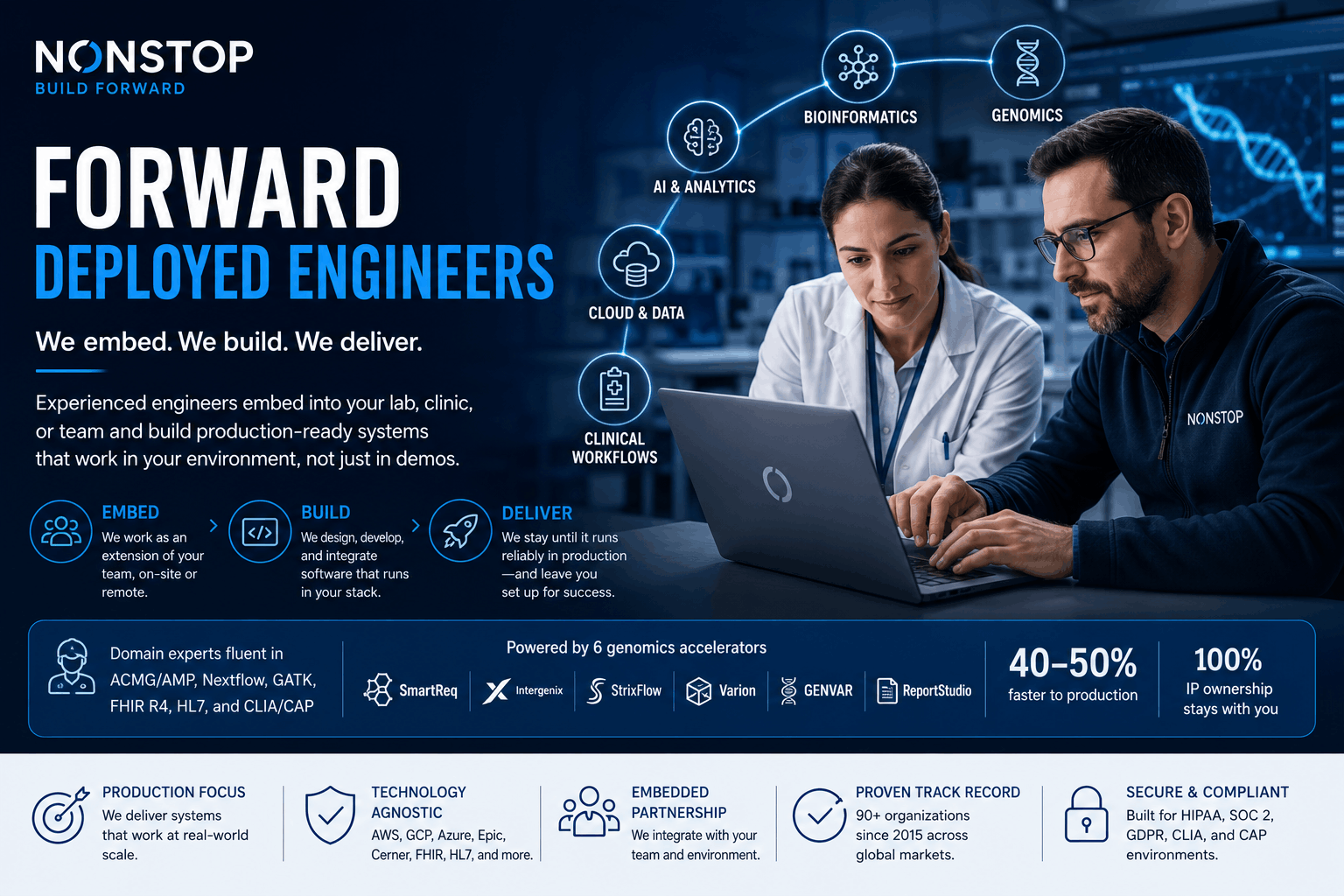
A forward deployed engineer works directly with your team, lab, or clinical environment to build and deploy software rather than simply providing recommendations or handing over a prototype.
This model is particularly useful for genomics organizations where projects involve complex bioinformatics workflows, clinical systems, healthcare interoperability, and regulatory requirements.
Why Forward Deployed Engineering Matters
Genomics software needs to work with real data, existing infrastructure, and real laboratory workflows. Embedded engineers can work alongside laboratory, clinical, data, and engineering teams to understand these requirements and solve problems within the actual environment.
What NonStop Offers
NonStop's engineers are familiar with technologies and standards including:
- ACMG/AMP
- Nextflow
- GATK
- FHIR R4
- HL7 v2
- AWS, GCP, and Azure
- Epic and Cerner
- Databricks and Snowflake
NonStop also uses six genomics accelerators: SmartReq, Intergenix, StrixFlow, Varion, GENVAR, and ReportStudio. The company states these can reduce initial development time by 40 to 50% compared with starting from scratch.
Where FDEs Can Help
Forward deployed engineering can support:
- Genetic laboratory modernization
- AI-assisted variant interpretation
- Bioinformatics platforms
- Clinical workflow automation
- EHR integration
- Genomic data platforms
- Laboratory reporting
- Healthcare software modernization
The Bottom Line
The value of an embedded engineering model is that the team stays involved beyond the demo. Engineers build within the customer's environment, integrate with existing systems, and remain engaged until the solution is working reliably in production.
For complex genomics and healthcare projects, genomics engineering combined with embedded delivery can provide a practical path from an idea or prototype to a production-ready system.

 Russian
