
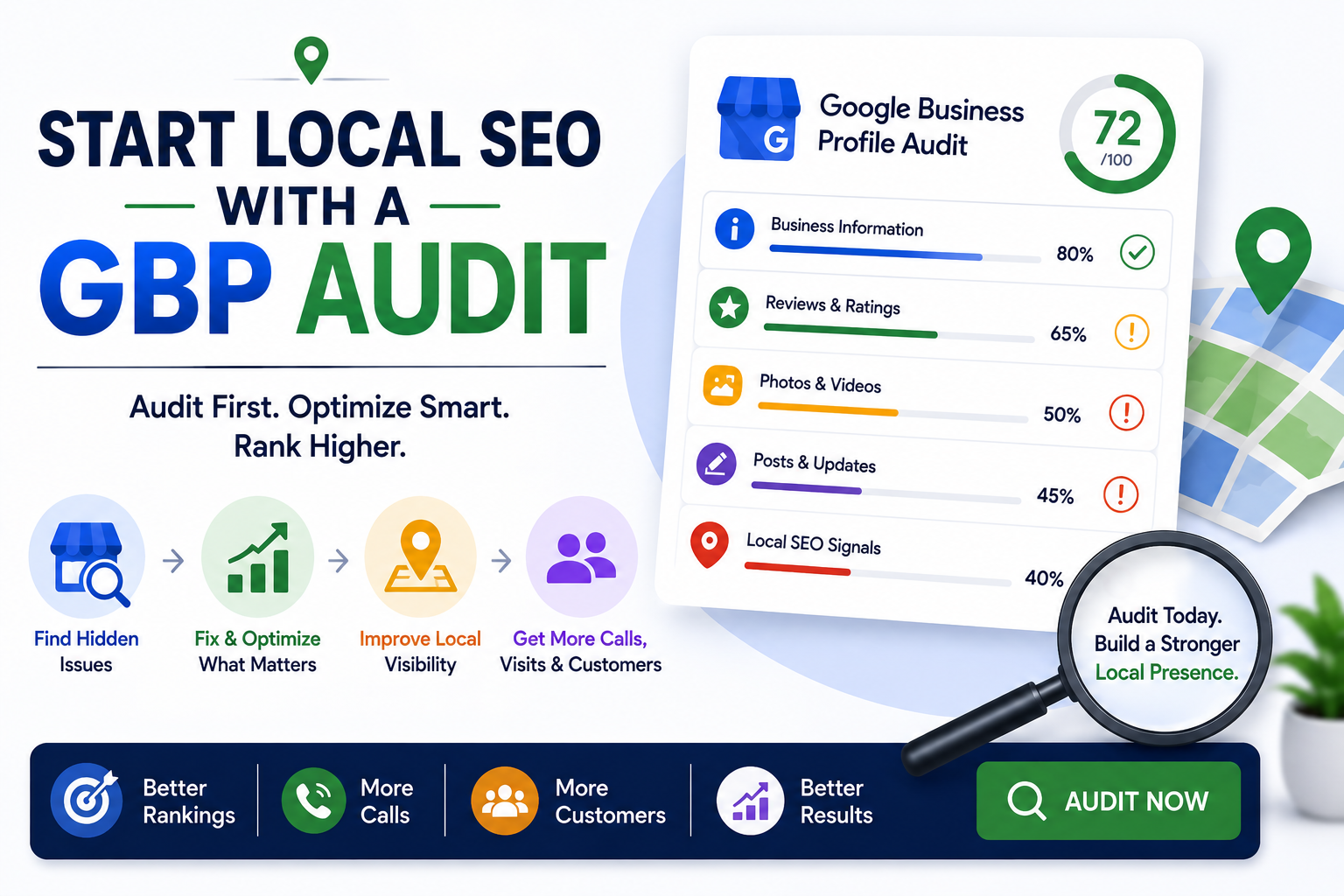
Starting a Local SEO campaign without first understanding the current condition of a business's Google presence can lead to wasted effort. You may start creating content, building citations, requesting reviews, or changing profile information without knowing what is actually limiting visibility.
That is why a Google Business Profile audit should be one of the first steps in a Local SEO campaign.
A GBP audit creates a baseline. It helps you understand whether business information is accurate, categories reflect the business correctly, important services are represented, reviews are healthy, and the profile provides customers with a clear path to contact the business.
More importantly, it helps distinguish between problems inside the profile and broader issues involving the website, competition, reputation, or geographic visibility.
A Local SEO Campaign Needs a Clear Starting Point
Every successful SEO strategy begins by understanding the current situation.
Local SEO should be no different.
Suppose a business is struggling to appear for important local searches. Without an audit, the immediate reaction might be to add more content, change categories, or increase profile activity.
But what if the real problem is an incorrect primary category?
What if the website URL on GBP is outdated?
What if competitors have significantly stronger reviews?
Or what if the business already performs well close to its location but appears lower farther away because of distance?
An audit helps answer these questions before time and budget are committed to solutions.
Start by Confirming Business Information
The first part of a GBP audit should focus on accuracy.
Review the business name, address or service area, phone number, website, opening hours, categories, and services.
Do not simply read the information. Test it.
Call the phone number. Open the website. Check the map location. Verify today's operating hours.
This matters because Local SEO is ultimately about connecting customers with businesses.
A profile can rank well and still fail if customers reach a disconnected phone number, incorrect location, or broken website.
Fixing these fundamental issues gives the campaign a cleaner foundation.
Categories Can Reveal Relevance Problems
Once the core information is verified, review the primary category.
The primary category should accurately describe what the business mainly does. Additional categories should represent genuine secondary activities.
A business may have selected a broad category when the profile was created years ago and never reviewed it again.
This creates an important audit opportunity.
Compare the client's categories with the services actually offered and with genuine competitors appearing for relevant searches.
If a more appropriate category genuinely represents the business, it may deserve consideration.
The objective is not adding categories for additional keywords. It is helping the profile represent the business as accurately as possible.
Audit Before You Optimize
Making profile changes without first identifying problems can make Local SEO unnecessarily complicated.
A structured audit can provide an initial overview of areas requiring attention.
Run a Google Business Profile Audit:
https://www.fly-social.com/tools/gmb-audit
Use the findings as the beginning of your investigation. Verify important issues manually and prioritize them according to their relevance to the business.
An automated score should not become the goal of the campaign. The goal is identifying genuine weaknesses and creating an improvement plan.
Services Can Expose Bigger Content Gaps
A GBP audit should also compare listed services with what the business actually offers.
Perhaps several high-value services are missing from the profile.
That is already useful information, but the analysis should go further.
Check whether those services are properly represented on the website.
If an important service is missing from both GBP and the website, the problem extends beyond profile optimization.
The Local SEO campaign may need stronger service information, dedicated website content, improved internal linking, or other supporting work.
This is why starting with an audit can uncover opportunities that influence the entire campaign.
Reviews Establish the Reputation Baseline
Customer reviews should be evaluated before launching a Local SEO campaign.
Do not look only at the average star rating.
Review total feedback, recent activity, owner responses, recurring customer comments, and competitor differences.
For example, a business may have a 4.9-star rating with 40 reviews. That sounds strong until you discover that the major competitors have 300–500 reviews and continue receiving new feedback regularly.
This does not mean review count alone determines rankings.
It does reveal a reputation gap worth investigating.
Starting with this information allows the campaign to include a realistic review strategy from the beginning rather than treating reviews as an afterthought.
An Audit Creates a Competitor Benchmark
Local SEO performance is relative to the competitive environment.
A profile cannot be evaluated properly without understanding the businesses competing for the same customers.
Choose three to five competitors that consistently appear for important searches.
Compare their categories, services, reviews, photos, websites, and overall digital presence.
Look for patterns.
If competitors consistently have stronger websites, website SEO may need greater priority. If their review profiles are substantially more active, reputation may deserve attention.
Competitor benchmarking at the beginning of the campaign gives you something valuable to measure against later.
It Helps Explain Geographic Ranking Differences
One of the biggest misunderstandings in Local SEO is expecting one fixed ranking position across an entire city.
Google Maps visibility can vary according to where the search takes place.
A business may appear prominently close to its physical location and significantly lower farther away.
A pre-campaign audit should therefore consider geographic visibility.
This prevents businesses from treating every low ranking as a profile problem.
It also creates more realistic expectations.
Instead of saying, "We need to get you into the top three everywhere," the campaign can focus on understanding where visibility is weak, where competitors dominate, and which improvements are realistically possible.
It Can Reveal Website Problems Early
A GBP audit often leads directly to website analysis.
Imagine the Business Profile is accurate, categories are appropriate, services are complete, and reviews are healthy.
Yet competitors still have stronger local visibility.
Now examine the websites.
Perhaps competitors have detailed service pages, useful local content, stronger organic rankings, or relevant backlinks while the client's website provides very limited information.
That changes the direction of the campaign.
Instead of spending months making minor GBP adjustments, resources can be directed toward website SEO and broader online prominence.
Starting with an audit helps prevent effort from being invested in the wrong area.
It Gives You a Performance Baseline
A Local SEO campaign needs measurable starting data.
Before making changes, document the current profile condition, review situation, competitor landscape, geographic visibility, and available customer interactions.
Then improvements can be compared against that baseline.
Do not measure only ranking positions.
Depending on the business, useful indicators may include calls, website visits, direction requests, bookings, enquiries, and other customer actions.
This helps answer a more meaningful question:
Is improved local visibility creating more business opportunities?
Without baseline data, demonstrating progress becomes much harder.
It Prevents Random Optimization
One of the biggest advantages of beginning with an audit is avoiding unnecessary changes.
When businesses see rankings fluctuate, they often start changing categories, descriptions, services, photos, and website links without knowing what caused the change.
A campaign based on audit findings is more controlled.
Correct factual problems first. Address genuine relevance gaps next. Then work on reviews, customer experience, website SEO, and broader visibility according to priority.
This makes Local SEO strategic rather than reactive.
It Helps Build a Better Campaign Roadmap
After the audit, findings can be organized into phases.
Immediate priorities may include correcting inaccurate information, fixing broken links, updating hours, and reviewing categories.
The next phase may focus on services, reviews, photos, and customer experience.
Longer-term work can involve website content, technical SEO, reputation, competitor gaps, backlinks, and broader local authority.
This provides both the SEO team and the business with a clear understanding of what happens next.
Look Beyond GBP When the Audit Is Complete
Sometimes an audit confirms that the Business Profile is already in strong condition.
That is not a failed audit.
It tells you that the next Local SEO opportunity probably exists elsewhere.
Explore additional SEO and digital marketing tools:
https://www.fly-social.com/tools
Website performance, organic visibility, competitor strength, and other areas can then become the focus rather than making unnecessary GBP changes.
Conclusion
Every Local SEO campaign should start with a Google Business Profile audit because you need to understand the current situation before deciding what to improve.
An audit establishes whether information is accurate, categories are appropriate, services are represented, reviews are healthy, competitors have obvious advantages, and geographic visibility is being measured realistically.
It can also reveal when the real problem exists outside GBP.
Most importantly, the audit creates a baseline and turns Local SEO into a prioritized strategy rather than a series of random optimization activities.
Start by understanding what is already working, identify the genuine gaps, and then invest time and budget where they can provide the most value.
A strong Local SEO campaign should not begin with "What should we change?"
It should begin with "What does the data show we actually need to improve?"
FAQs
Why should a Local SEO campaign start with a GBP audit?
An audit establishes the current condition of the profile and identifies genuine problems before optimization work begins.
What should be included in the initial GBP audit?
Review business information, categories, services, reviews, photos, competitors, website connections, geographic visibility, and customer actions.
Can a GBP audit identify website SEO opportunities?
Yes. Comparing profile information and competitors can reveal service-content, organic visibility, and broader website weaknesses.
Does every GBP audit require profile changes?
No. Sometimes the profile is already strong, and the better opportunities exist in website SEO, reputation, competition, or broader Local SEO.

 English
