
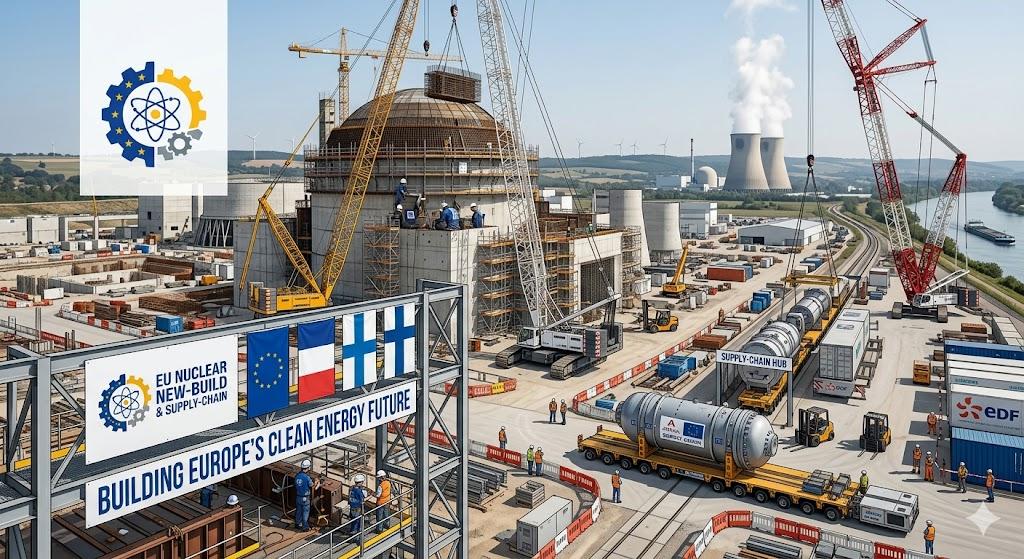
Europe Nuclear New-Build: Technology, Investment, and Supply Chains
Europe's nuclear new-build ambitions are creating a strategic conversation about how energy policy and industrial policy can reinforce one another. New reactors can contribute dependable low carbon electricity, but their construction also depends on specialized manufacturing, advanced engineering, skilled labor, reliable logistics, and strong regulatory institutions. The supply chain is therefore not simply a support function; it is a major determinant of project feasibility and delivery.
Governments considering new nuclear capacity must look beyond headline generation targets. They need to assess whether domestic and regional industries can meet procurement requirements, whether qualified suppliers have sufficient capacity, and whether critical components can be delivered within project schedules. Where gaps exist, policy measures may encourage investment in factories, training, research, certification, and technology development.
Industrial localization can offer several benefits. A stronger regional supplier base may reduce exposure to international disruptions, improve delivery coordination, and preserve technical expertise. Local participation can also create economic value through employment, manufacturing orders, engineering contracts, and service activity. Yet localization should be based on commercial and technical realities. Nuclear projects require specialized capabilities, and building duplicate capacity without a sustainable pipeline can create unnecessary costs.
Procurement transparency can help address this challenge. Early publication of expected packages, qualification criteria, delivery timelines, and technical requirements gives suppliers time to prepare. Companies can then evaluate whether to invest in certification, machinery, recruitment, partnerships, or facility upgrades. Developers also benefit because a larger pool of prepared suppliers can improve competition and reduce bottlenecks.
The role of major contractors is evolving as well. Large engineering and construction organizations can integrate complex project packages, coordinate international suppliers, and manage demanding schedules. Smaller specialist companies remain essential for precision manufacturing, inspection, testing, software, maintenance, and niche engineering services. Effective supply-chain strategies should connect these layers rather than treating them as separate markets.
Financing remains closely linked to industrial readiness. Investors are more likely to support projects when costs, schedules, responsibilities, and risks are clearly defined. Supplier commitments can strengthen project credibility, while uncertainty about procurement or construction capacity can increase perceived risk. As a result, commercial agreements with key vendors may become important milestones in the development process.
The Europe Nuclear New-Build & Supply-Chain Market Report context provides a useful framework for examining these interconnected opportunities. Market stakeholders can evaluate planned projects alongside equipment demand, supplier capabilities, technology pathways, policy developments, and lifecycle services. This approach offers a broader view of where value may be created as European nuclear investment develops.
Small modular reactors could add another dimension to industrial strategy. Their proposed factory-oriented production model may increase the importance of repeat manufacturing, modular assembly, standardized components, and specialized transportation. If multiple units are deployed, suppliers could gain greater production visibility and opportunities to improve efficiency through repetition. However, licensing and commercial deployment remain crucial to realizing this potential.
The future workforce will also influence competitiveness. Nuclear projects require technical knowledge across engineering, construction, quality control, safety, operations, cybersecurity, and project management. Education providers and industry need to coordinate training programs that combine theoretical knowledge with practical experience. International collaboration can also support knowledge transfer and broaden access to specialized expertise.
Supply-chain resilience extends into fuel and lifecycle support. New reactors require dependable fuel arrangements, maintenance services, spare parts, inspection capabilities, waste management, and eventual decommissioning. Companies that consider these stages can identify recurring opportunities rather than focusing only on construction contracts. Lifecycle planning can also help developers evaluate total project value more effectively.
Europe's nuclear market will ultimately depend on execution. Political commitments create momentum, but industrial capacity, financing, regulation, skills, procurement, and project management determine whether that momentum becomes operating infrastructure. Businesses that monitor these factors can better identify emerging demand and prepare for qualification requirements.

 English
