
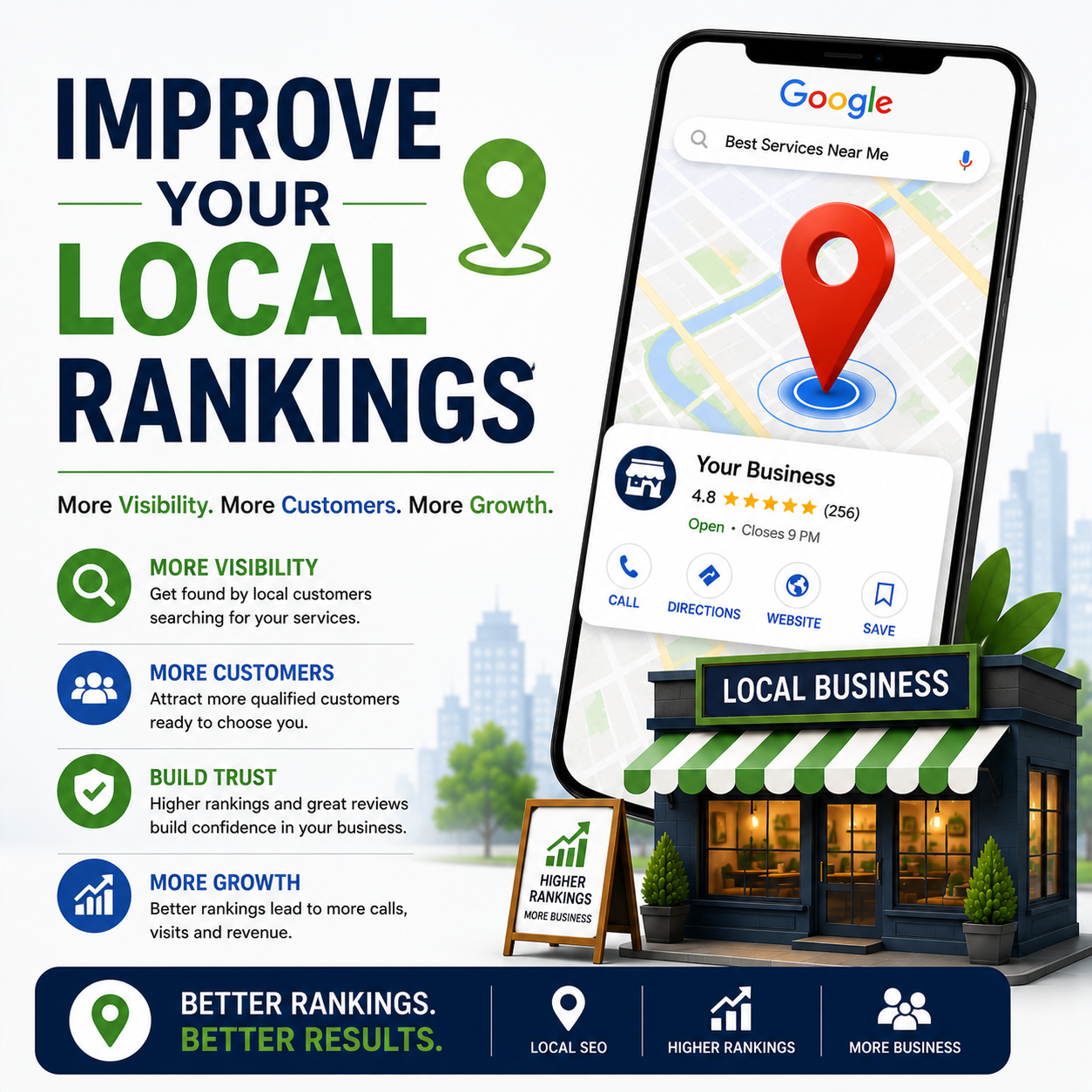
When people need a nearby product or service, many turn to Google to find their options. They may search for a specific service, compare local businesses, read reviews, visit websites, and decide which company deserves their attention.
For a local business, being visible during these searches can create valuable opportunities. However, improving local rankings is not simply about adding more keywords to a website or making occasional changes to a Google Business Profile.
A stronger approach is to make your entire local presence more accurate, relevant, useful, and trustworthy.
Here are practical ways to improve your local rankings while making it easier for potential customers to discover and choose your business.
Begin With the Searches Closest to Your Services
Before making SEO changes, understand what you actually want to be found for.
Create a list of your main services or products. Then consider how customers describe those services when searching.
For example, people may search using:
- A specific service
- A service combined with a location
- A problem they need solved
- A particular product or business category
Do not choose keywords only because they appear popular. A highly relevant search from someone who needs exactly what you provide can be more valuable than a broad search generating visitors who are unlikely to become customers.
Prioritize relevance and customer intent.
Give Google Clear Information About Your Business
Google needs to understand what your business does before it can connect your company with relevant local searches.
Make your business information clear across your website and Google Business Profile.
Avoid vague language such as:
“We provide complete solutions for all your needs.”
Instead, clearly name and explain the services you actually offer.
Your homepage should quickly communicate your main business activity, while important services can be explained through dedicated pages when there is enough useful information to justify them.
Clarity helps both customers and search engines understand your business.
Improve Your Google Business Profile
Your Google Business Profile can be one of the first interactions potential customers have with your company.
Review the profile carefully and make sure the information represents your real business.
Check your:
Business name: Use the genuine business name rather than adding unnecessary keywords.
Category: Select a primary category that accurately describes your main activity.
Contact details: Keep your phone number and website correct.
Address or service area: Clearly represent where the business operates.
Opening hours: Update regular and special hours when necessary.
Services: Add services that you genuinely provide.
A complete profile is useful, but accuracy should always come before simply filling fields.
Strengthen Pages for Your Most Valuable Services
A potential customer may discover your website through a search for one particular service.
If they land on a page containing very little useful information, they may leave.
Important service pages should answer the questions customers are likely to have.
Explain what the service is, what situations it addresses, what customers can expect, and what their next step should be.
Avoid writing pages only for search engines.
A useful test is to read the page and ask:
“If I knew nothing about this service, would this page help me understand it?”
If the answer is no, the content probably needs improvement.
Make Your Location Easy to Understand
Your website should clearly communicate where your business operates.
If customers visit your physical location, make the address and relevant contact information easy to find.
Service-area businesses should clearly explain the areas they genuinely cover.
Businesses with multiple branches can create individual location pages when those pages contain useful information about each location.
For example, a branch page might include its address, opening hours, available services, contact information, directions, and location-specific FAQs.
Avoid creating hundreds of thin pages where the only difference is the city name.
Use Customer Questions to Find Search Opportunities
Some of your best SEO ideas may already exist inside your business.
Look at the questions customers ask before buying, booking, or making an enquiry.
What are they confused about?
What do they compare?
What problems are they trying to solve?
What information do they need before making a decision?
Turn useful questions into website content.
A customer may first discover your business through an article answering a problem. They can then explore the related service and eventually contact you.
This creates a natural journey:
Question → Answer → Service → Enquiry
Content built around real questions is usually more useful than publishing articles simply to meet a monthly blog target.
Build Customer Trust Through Genuine Reviews
Appearing prominently in Google does not automatically mean someone will choose your business.
Potential customers may compare several companies before making contact, and reviews can influence that comparison.
Encourage genuine customers to leave feedback after real experiences.
Pay attention to more than the overall rating. Look at recent reviews, recurring comments, customer concerns, and how your business responds.
Responses should sound natural and relevant to the customer's feedback.
Avoid using exactly the same copied response under every review.
A healthy review profile should help potential customers understand what real people experience when dealing with your business.
Improve What Happens After Someone Clicks
Local SEO should not stop when someone reaches your website.
The website needs to help that visitor take the next step.
Check your site on a smartphone and ask:
Can visitors understand your business quickly?
Are important services easy to find?
Can they see where you operate?
Can they easily call, book, request a quote, or submit an enquiry?
Avoid hiding contact options or making customers complete unnecessarily complicated forms.
Potential customers often compare multiple businesses. A difficult website experience can send them directly back to the search results.
Look for Local Authority That Makes Business Sense
Your local online presence can become stronger when relevant websites and organizations mention your business.
Potential opportunities may come from industry associations, suppliers, local organizations, business partnerships, community involvement, or relevant publications.
Do not collect random backlinks simply because someone claims they will improve your rankings.
Focus on relevance.
A simple question can help:
“Could this mention introduce our business to a relevant audience?”
If the answer is yes, it may provide genuine marketing value in addition to any SEO benefit.
Understand Where You Are Actually Visible
Local rankings can change depending on the location of the person searching.
Your business might perform strongly near its physical location but have weaker visibility farther away.
That means one manual Google search cannot provide a complete picture.
Track your visibility across important searches and relevant geographic areas where possible.
This can reveal patterns that a single ranking number cannot show.
You may discover that one service performs well while another needs attention, or that visibility is strong in one part of your service area but weaker elsewhere.
These insights can help you prioritize future improvements.
Learn From Competitors Without Copying Them
Competitors can provide useful context.
Review businesses that consistently appear for your important searches.
Look at how they present their services, customer reviews, website information, Google Business Profile, content, and overall user experience.
Then compare those areas with your own business.
The goal is not to duplicate what competitors are doing.
Look for gaps you can improve.
Perhaps competitors provide better answers to customer questions. Maybe your service pages are stronger but your profile information is outdated.
Find the weaknesses that actually matter.
Measure Customers, Not Just Rankings
A higher Google position can increase visibility, but rankings should connect to business outcomes.
Track meaningful actions such as:
- Phone calls
- Website enquiries
- Bookings
- Appointments
- Direction requests
- Qualified leads
Consider both visibility and conversion.
If your rankings improve but enquiries do not, investigate what happens after customers discover you.
They may be comparing your reviews with stronger competitors. Your website may not clearly explain the service, or your contact process may create unnecessary friction.
Rankings tell you whether customers can find you. Customer actions tell you whether your online presence is convincing them to move forward.
Keep Improving Instead of Looking for Quick Fixes
Local SEO is rarely improved by one dramatic change.
Businesses evolve. Services change. New competitors enter the market. Customers leave new feedback, and search behaviour develops over time.
Review your local presence regularly.
A simple improvement process can be:
Find the Problem → Understand the Cause → Make the Improvement → Measure the Result
This is more useful than repeatedly changing keywords or profile information without understanding what actually needs attention.
Build Stronger Local Visibility With ZoomLocal
Managing your Google Business Profile, website, customer reviews, local rankings, and content together can require consistent attention.
If you want to strengthen how your business appears across local Google searches, explore ZoomLocal.
A structured Local SEO approach can help identify where your current visibility is weak, prioritize meaningful improvements, and build a stronger online presence around the customers you actually want to reach.
Conclusion
Improving your local rankings is not simply about trying to reach the first position for one keyword.
The bigger objective is to make your business easier to find, understand, trust, and contact.
Start by targeting searches connected to your real services. Keep your Google Business Profile accurate, strengthen important website pages, answer genuine customer questions, encourage authentic reviews, and improve your website experience.
Then track whether those improvements are helping potential customers take action.
When Local SEO is approached this way, better rankings become part of something more valuable: creating a stronger connection between people searching for a solution and your business being ready to provide it.

 Russian
